
Building Visibility for the Next Generation of Search
The way businesses discover laboratory furniture suppliers is changing. Traditional Google rankings remain important, but buyers are increasingly encountering brands through Google AI Overviews, generative search features, ChatGPT, Perplexity and other AI-powered research experiences.
For LabTech Supply Co., this created an opportunity to build on an already growing organic search presence and make the company more visible wherever AI systems answer questions, compare solutions and help buyers evaluate potential vendors.
Brandastic developed a search strategy that combined traditional SEO with answer-engine optimization. The work focused on strengthening LabTech’s core service and product content while making its expertise easier for both search engines and generative AI systems to understand, retrieve and cite.
The results show a clear progression. Visibility within Google searches featuring generative AI has increased substantially since May, LabTech has earned measurable mentions and citations across AI search platforms, favorable sentiment has remained consistently high, and the brand has become increasingly competitive with established laboratory furniture companies.
The Challenge
LabTech operates in a specialized market where prospective customers research everything from laboratory benches and casework to modular systems, furniture materials and complete laboratory buildouts before selecting a supplier.
The company had significant real-world expertise, but AI search introduced a different challenge. Generative systems tend to surface brands whose capabilities are clearly documented through detailed service pages, technical resources, structured educational content, comparison information and other sources that are easy to interpret and cite.
In other words, LabTech did not simply need more content. It needed a digital footprint that clearly communicated what the company does, the problems it solves and why it belongs in conversations about laboratory furniture and design.
That became the foundation of the SEO and AEO strategy.
Creating an AI-Ready Search Foundation
The strategy began by strengthening the same signals that support both organic rankings and AI discovery. LabTech expanded its coverage of important product categories and materials while improving existing pages with clearer headings, stronger internal linking, FAQs, structured data recommendations and more comprehensive explanations.
Educational content was also developed around the questions buyers ask while planning laboratory environments. Instead of focusing only on isolated keywords, the content addressed broader decision-making topics such as furniture materials, casework selection, modular versus fixed systems, budgeting, laboratory expansion, ergonomics and full-service project support.
This approach created a deeper body of information around LabTech’s core expertise. The goal was to make the website useful not only to someone clicking through a traditional search result, but also to the AI systems deciding which sources and companies should be referenced when answering laboratory furniture questions.
Generative Search Visibility Has More Than Doubled
One of the clearest indicators of progress appears directly within Google Search Console data for searches associated with generative AI features.
Since tracking began in May, LabTech has seen a sustained increase in impressions from searches containing generative search experiences. Average daily impressions increased from approximately 437 during the initial May measurement period to approximately 885 in September.
That represents an increase of roughly 103%.
More importantly, the trend has been consistent rather than being driven by a single short-term spike. Average daily impressions increased from approximately 612 in June to 719 in July, 826 in August and 885 in September.
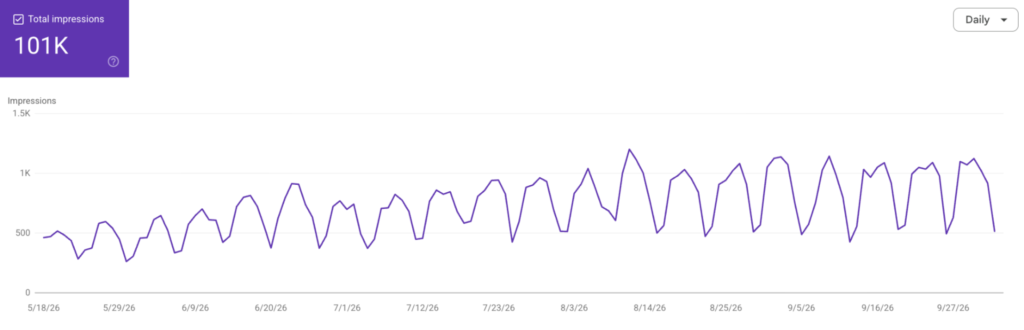
This growth shows that LabTech pages are increasingly being exposed within the search environment where Google is layering AI-generated answers and recommendations into traditional results.
It is an important distinction from simply ranking higher in standard search. LabTech is gaining visibility as the search experience itself becomes more generative.
Building a Presence Inside AI-Generated Answers
Google’s generative search features are only part of the story. Dedicated AI visibility reporting has also shown LabTech being surfaced, cited and positioned within AI-generated answers across multiple platforms.
At one of its strongest measured points, LabTech achieved an 11.78% share of voice within Google AI Mode, received 49 AI mentions and 61 citations, and appeared at an average position of 2.08 when included. LabTech was also the second-most cited domain within its competitive group.
Broader answer-engine measurement subsequently recorded 182 AI mentions and 187 domain citations, demonstrating that LabTech had progressed beyond occasional AI exposure and had become part of a wider set of AI-generated discussions around laboratory furniture.
Because AI platforms, prompt sets and measurement methodologies continue to evolve, these figures are best viewed as evidence of visibility rather than a traditional month-over-month KPI. The more important takeaway is that LabTech is now being retrieved and cited when AI systems construct answers relevant to its market.
Favorable Sentiment Became a Competitive Strength
Being mentioned by an AI system is only valuable if the brand is represented accurately and positively. This has become one of LabTech’s strongest signals.
AI sentiment measurements have consistently shown overwhelmingly favorable perceptions of the brand, ranging from approximately 93% to nearly 98% favorable across available reporting.
When LabTech is surfaced, AI systems tend to associate the company with customization, durable laboratory-grade furniture, flexible and reconfigurable environments, full-service capabilities, fast lead times and experience serving California laboratory projects.
That distinction is important. The opportunity is no longer simply to improve how AI systems perceive LabTech. The brand already performs well from a sentiment standpoint. The next challenge is increasing the frequency with which LabTech is selected, cited and recommended.
Closing the Gap With Larger Competitors
AI visibility reporting also provided a much clearer view of LabTech’s competitive position.
LabTech reached a point where its AI share of voice was nearly level with its top competitor while exceeding several other competing laboratory furniture brands. At the same time, the analysis revealed why certain competitors continued to earn more frequent citations.
The primary gap was not necessarily capability. It was the volume of publicly available evidence supporting those capabilities. Competitors with extensive catalogs, technical documentation, project examples, specification resources, sustainability information and case studies give AI systems more material to reference when constructing an answer.
That insight has changed the way LabTech’s content strategy is approached. Instead of creating content based exclusively on search volume, Brandastic can now use AI visibility data to identify subjects where competitors are earning citations and create stronger resources around LabTech’s actual expertise.
The AI visibility analysis specifically identified additional opportunities around technical documentation, project proof, compliance and safety information, California experience and full-service laboratory buildout capabilities.
Using AI Visibility to Guide Content Strategy
This feedback loop is one of the most important developments in the engagement. AI visibility is no longer something measured only after content has been published. The findings are now helping determine which content should be created next.
If AI systems frequently cite competitors when explaining laboratory casework, LabTech can strengthen its own casework resources. If modularity, technical specifications or full-service capabilities influence vendor recommendations, those subjects can be documented more thoroughly. If competitors are benefiting from project examples or compliance resources, those gaps can become part of the content roadmap.
The strategy therefore continues to evolve from traditional keyword targeting toward a broader goal: building the collection of useful, authoritative and citable information necessary for LabTech to become a more consistent source within AI-generated answers.
Organic Search Provides the Foundation
The growth in AI visibility has occurred alongside continued improvement in LabTech’s underlying organic search footprint.
Search impressions increased from approximately 170,000 to 193,000 as the program progressed, while the number of ranking organic keywords grew from 2,092 to 2,570. That represents approximately 23% growth in ranking keyword coverage.
LabTech has also reached the number-one organic position for several commercially important terms, including “lab workstation,” “computer workbenches,” “laboratory design services,” “IT workbench” and “lab furniture solutions.”
Beyond those number-one positions, additional priority terms have moved into the top three and top five results, including searches related to lab benches, modular lab benches, laboratory cabinets, bench materials, furniture installation and laboratory work surfaces.
These gains matter to the AI visibility story because they demonstrate increasing topical authority around the same subjects AI systems are being asked to explain and recommend.
What the Results Mean
LabTech’s progress illustrates how search visibility is expanding beyond the traditional results page.
The company has more than doubled its average daily impressions within Google searches featuring generative AI since the initial May measurement period. It has earned measurable mentions and citations within dedicated AI platforms, maintained consistently favorable sentiment and strengthened its competitive position against established laboratory furniture brands.
At the same time, the data has revealed exactly where the next opportunities exist. LabTech’s biggest competitive gap is not the quality of its offering, but the amount of structured, public evidence available for AI systems to retrieve and cite.
That gives the next phase of the strategy a clear direction: create more authoritative resources that document LabTech’s expertise, projects, technical capabilities and differentiators while continuing to strengthen the organic search foundation underneath them.
From AI Visibility to AI Authority
The next goal is not simply to appear in AI-generated answers more often. It is to make LabTech one of the brands AI systems consistently recognize as a credible source when buyers research laboratory furniture.
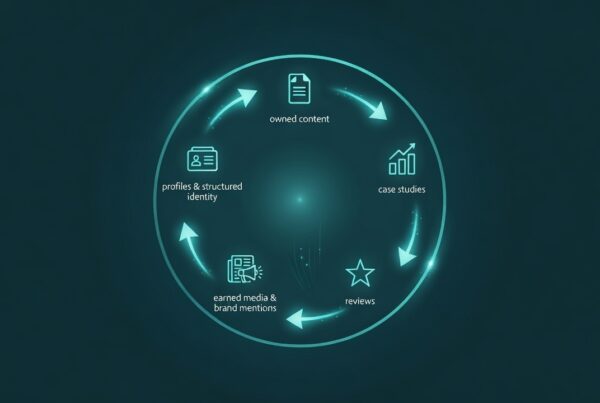
That means continuing to develop stronger case studies, technical resources, project documentation, planning guidance and proof around LabTech’s core capabilities. Each new asset adds another opportunity for search engines and AI platforms to understand the company, associate it with the right topics and cite it when those topics are discussed.
LabTech’s progress demonstrates that AI visibility is not created through a single optimization or platform. It develops by building a strong organic foundation, publishing genuinely useful information, documenting real expertise and making that expertise easy for both people and AI systems to find, understand and trust.