Your product pages rank on the first page. Your Google Shopping ads are profitable. Your conversion rate is above the industry average. And none of that will protect you from what’s happening right now.
AI search engines are rewriting how consumers discover and buy products. When someone asks ChatGPT “what’s the best running shoe for flat feet under $150” or tells Perplexity to “compare ceramic cookware sets with the best nonstick ratings,” those platforms don’t return a list of blue links. They return direct answers — with product recommendations, pricing, and purchase paths baked in. The product pages that show up in those answers are getting the sale. The ones that don’t are invisible in the fastest-growing discovery channel in ecommerce.
According to McKinsey, half of consumers now intentionally seek out AI-powered search engines, with a majority saying it’s the top digital source they use to make buying decisions. By 2028, an estimated $750 billion in US revenue will funnel through AI-powered search. The brands that are already optimizing their product pages for this shift aren’t just future-proofing — they’re capturing demand that competitors don’t even know exists.
Here’s what your product pages need right now to show up where AI shopping search is actually happening.
The Shift from Rankings to Recommendations
Traditional ecommerce SEO was built on a predictable model: optimize product titles and descriptions for keywords, build backlinks, earn rich snippets, and climb the search results page. The buyer clicked through, compared options across tabs, and made a decision.
That model is fracturing. Research from SparkToro shows that for every 1,000 Google searches in the US, only 360 result in a click to the open web. The rest are resolved within the search results — by AI Overviews, featured snippets, knowledge panels, or abandonment after the user found their answer without clicking.
For ecommerce, the implications are severe. When a shopper asks an AI assistant to recommend a product, the AI doesn’t show ten blue links. It synthesizes information from trusted sources and presents a curated answer. Your product is either in that answer or it isn’t. There is no position #4 to fall back on.
This isn’t replacing traditional SEO — it’s layering on top of it. The pages that perform well in organic search are often the ones AI systems pull from. But “performing well” in AI search requires product pages to be structured in ways that go beyond what traditional optimization has demanded.
Why Product Schema is Now the Price of Entry
Structured data is one of the most important technical foundations for ecommerce AI visibility because it helps search engines and AI systems interpret product details more accurately. Specifically, Product schema implemented via JSON-LD.
AI search engines don’t read your product pages the way humans do. They parse structured data to extract clean, unambiguous facts: product name, price, availability, ratings, brand, SKU, and identifiers like GTIN. When product data is complete and accurate, AI systems have a clearer basis for understanding and surfacing the product. Missing or inconsistent data can reduce eligibility and make competing products easier to interpret.
A SALT.agency audit of the top 100 ecommerce sites found that 45% of product URLs contained no structured data at all, and another 27% had errors. That means 72% of even the largest retailers are either invisible or broken for AI systems. Correct implementation doesn’t just meet a minimum bar — it creates immediate competitive separation from nearly three-quarters of the market.
The Properties That Matter Most
Not all Product schema properties serve the same purpose. The following fields are especially important for product understanding, merchant eligibility and accurate shopping experiences:
Required for AI visibility:
- name — The exact product name as the AI should reference it
- description — A specific, differentiating description (not marketing fluff)
- image — High-quality product image URL
- offers.price — Current price
- offers.priceCurrency — Currency code (the single most commonly missing property)
- offers.availability — Real-time stock status
AI-critical competitive advantage:
- brand — Entity disambiguation across retailers
- sku — Unique product identification at the retailer level
- gtin/gtin13 — Universal product matching across all AI surfaces
- aggregateRating — Trust signal AI systems weight heavily for recommendation ranking
- review — Social proof that Ai extracts for answer generation
Recommended for merchant listing eligibility:
- shippingDetails — Purchase-intent query matching
- hasMerchantReturnPolicy — Consumer trust and merchant listing eligibility
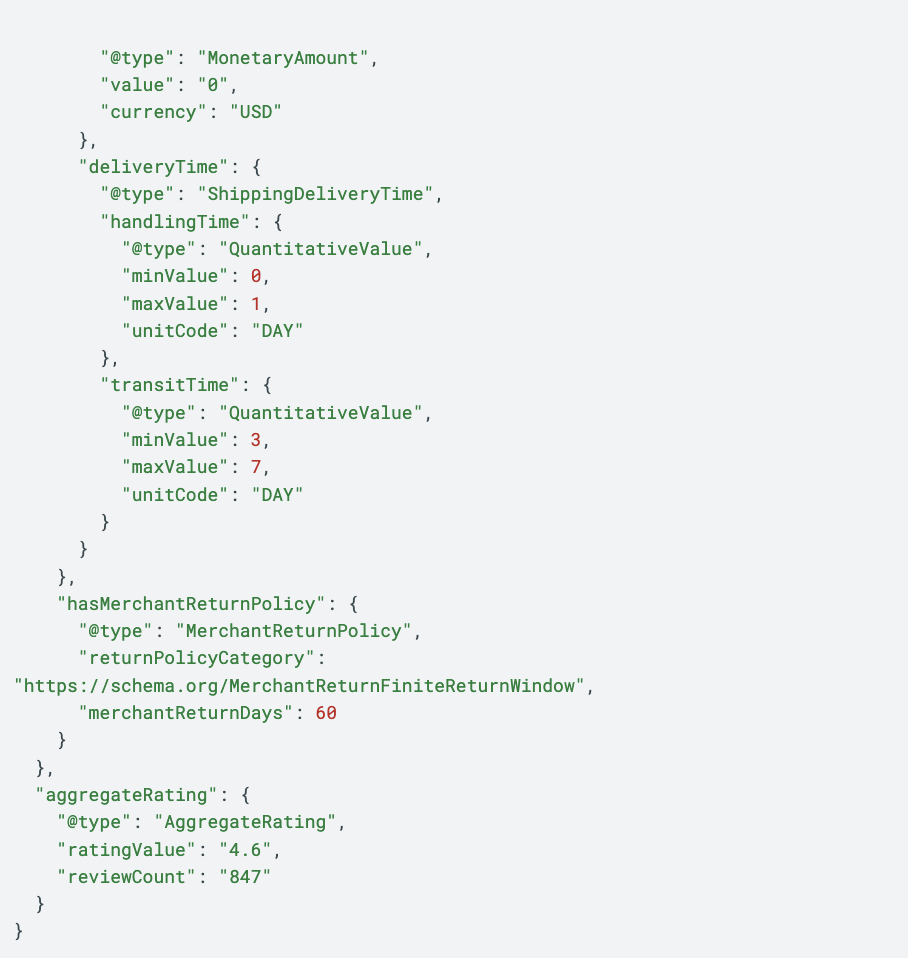
The key principle: AI systems cite product pages when they can answer a shopping query without ambiguity. Every missing property is a reason for the AI to choose a competitor’s page instead.
Product Feed Optimization: The Hidden Layer
Product schema gets your individual pages ready for AI citation. Product feed optimization ensures your entire catalog is discoverable across the AI shopping ecosystem.
AI search engines increasingly pull product data not just from crawling individual pages, but from structured product feeds — the same feeds that power Google Shopping, Meta Catalog ads, and marketplace listings. When your feed data is clean, complete, and accurate, it feeds the AI systems that power Google AI Overviews, ChatGPT Shopping, and Perplexity’s product recommendations.
What AI Shopping Engines Look for in Your Feed
Title optimization matters more than ever. AI systems parse product titles to match against natural language queries. A title like “Men’s Shoe – Black – Size 10” gives the AI almost nothing to work with. A title like “TrailForge ProTrail GTX Waterproof Hiking Boot – Men’s, Black, Size 10, Wide Width” provides the specificity AI needs to recommend your product for queries like “waterproof hiking boots for wide feet.”
Product descriptions must answer questions, not just describe features. Traditional product descriptions list specifications. AI-optimized descriptions anticipate and answer the questions shoppers actually ask. Instead of “Gore-Tex waterproof membrane,” write “Keeps feet dry in rain, stream crossings, and wet trail conditions thanks to a Gore-Tex waterproof membrane.” The AI can extract that answer directly.
Category accuracy affects surfacing. Incorrect or overly broad Google Product Categories limit where your brand appears in AI-generated shopping recommendations. Audit your feed categories quarterly. The Google Product Taxonomy is updated regularly, and the most specific category always wins.
Image quality can influence product presentation, usability and eligibility across shopping surfaces. Use high-resolution, accurate product images that meet each platform’s feed and merchant requirements. AI shopping surfaces increasingly display product images alongside recommendations. Products with high-resolution, clean-background images on white backgrounds outperform those with lifestyle shots or low-resolution alternatives in structured ecommerce contexts.
Content Architecture: Writing Product Pages AI Engines Actually Cite
Getting the technical foundation right with schema and feeds is necessary but not sufficient. The on-page content of your product pages determines whether AI systems trust your page enough to cite it — and what they say about your product when they do.
Structure Content for AI Extraction
AI systems extract information more reliably from content that’s clearly structured with headings, lists, tables, and FAQ sections. This isn’t about keyword density — it’s about making your content parseable.
Use comparison tables. When shoppers ask AI systems “what’s the difference between [Product A] and [Product B],” the AI looks for direct comparison data. Comparison tables can make product differences easier for users and retrieval systems to understand, especially when they present clear, factual distinctions between related products.
Add a “Best For” section. A clear statement of who the product is ideal for — “Best for day hikers on mixed terrain who need wide-width options” — gives Ai systems a ready-made recommendation statement. This is the exact language that appears in AI shopping responses.
Include constraint-based answers. Constraint-based queries such as “best [product] under $[price] with [feature] for [use case]” are common in AI-assisted shopping. Product pages should clearly address price, features, compatibility and intended use so they can match these high-intent questions
Build FAQ Sections That AI Systems Mine
FAQ sections on product pages serve a dual purpose: they improve traditional SEO through featured snippet eligibility, and they provide AI systems with clean question-answer pairs that can be extracted directly into responses.
Effective product page FAQs answer the question shoppers actually ask before purchasing:
- Is this product compatible with [common accessory/system]?
- How does this compare to [competitor product]?
- What’s the return policy and warranty?
- What are the dimensions/weight/material specifications?
- Does this work for [specific use case]?
Each answer should be 2-4 sentences — long enough to be useful, short enough for AI to extract without summarization. Include specific data points: measurements, compatibility lists, and certifications.
Allowing AI Crawlers Access
Your product pages might be perfectly optimized and completely invisible to AI systems because your robots.txt file is blocking their crawlers. This is more common than most ecommerce teams realize.
The major AI crawlers to ensure access for:
- GPTBot (OpenAI / ChatGPT Search)
- Google-Extended (Google AI Overviews and Gemini)
- PerplexityBot (Perplexity)
- Applebot-Extended (Apple Intelligence)
- ClaudeBot (Anthropic / Claude)
- cohere-ai (Cohere)
Check your robots.txt file. If these crawlers are blocked, they may be unable to access your product pages directly. Review crawler access based on your content, privacy and licensing strategy rather than assuming every bot should be allowed. The fix is simple — but the damage from leaving it in place compounds daily as AI search traffic grows.
Some platforms are also adopting the emerging llms.txt standard, which provides AI systems with a structured summary of your site’s most important content. For ecommerce sites, this can include links to top product categories, bestsellers, and comparison guides — essentially creating a curated entry point for AI crawlers.
Measuring AI Shopping Visibility
Traditional analytics can’t measure what’s happening in AI search. When ChatGPT recommends your product, there’s no impression logged in Google Analytics. When Perplexity cites your product page, the referral traffic looks different from organic search.
The metrics that matter for ecommerce AI search:
- AI citation frequency — How often your products appear in AI responses for relevant shopping queries
- AI share of voice — Your citation rate compared to competitors for the same product category
- AI referral traffic — Traffic from AI search sources (look for referrers containing chatgpt.com, perplexity.ai, and bing.com/copilot)
- Conversion rate from AI traffic — AI search traffic converts at significantly higher rates than organic — AI-referred traffic may arrive with stronger purchase intent because users have already researched and compared options. Measure conversion rate, revenue per session and average order value in your own analytics, and verify any external benchmark before publishing it.
Start tracking by running your top product queries through ChatGPT, Perplexity, and Google AI Mode manually. Note which products (yours or competitors’) appear in the responses. This baseline tells you exactly where the gaps are.
What to Do This Week
The gap between ecommerce brands that are optimizing for AI search and those that aren’t is widening rapidly. Here’s how to start closing it:
- Audit your Product schema. Use Google’s Rich Results Test on y our top 20 product pages. Fix missing priceCurrency, availability, and brand properties first.
- Check your robots.txt. Verify that GPTBot, PerplexityBot, and Google-Extended are not blocked. One line in a config title could be excluding you from the entire AI shopping ecosystem.
- Rewrite your top 10 product descriptions. Shift from feature-listing to question-answering. Include “Best For” statements and constraint-based language that maps to how shoppers actually query AI assistants.
- Add FAQ sections to your highest-traffic product pages. Start with five questions per page, using the actual questions customers ask your support team or leave in reviews.
- Clean up your product feed. Ensure titles are descriptive and specific, categories are accurate, and all required attributes are populated. This single step can improve AI shopping visibility across multiple platforms simultaneously.
- Set up AI traffic tracking. Create segments in your analytics for ChatGPT, Perplexity, and Copilot referral traffic. You can’t optimize what you can’t measure.
The ecommerce brands that take these steps now will own the AI shopping surface for their categories. The ones that wait will spend the next two years trying to catch up.
Need help optimizing your ecommerce product pages for the AI search era? Brandastic is a full-service digital marketing agency specializing in SEO, ecommerce marketing, and Shopify development — with offices in Orange County, Los Angeles, and Dallas. Contact us for a free consultation and find out how your product pages stack up in the new AI shopping landscape.
Frequently Asked Questions
What is ecommerce AI search?
Ecommerce AI search refers to AI-powered platforms like ChatGPT Shopping, Google AI Overviews, and Perplexity that directly recommends products in response to shopping queries instead of showing traditional search results listings. These platforms synthesize information from product pages, structured data, and merchant feeds to generate curated purchase recommendations.
What product schema do ecommerce pages need for AI search?
At minimum, product pages need KSON-LD Product schema with name, description, image, and a complete Offer object including price, priceCurrency, and availability. For competitive advantage, include brand, sku, gtin, aggregateRating, shippingDetails, and hasMerchantReturnPolicy. AI systems prioritize pages where they can answer shopping queries without ambiguity.
How does product feed optimization affect AI shopping visibility?
Product feeds power the data layer behind Google Shopping, ChatGPT Shopping, and other AI commerce platforms. Clean, complete feeds with specific product titles, accurate categories, and fully populated attributes ensure your products surface in AI-generated shopping recommendations. Incomplete or generic feed data limits where and how often your products appear.
Does AI search traffic actually convert for ecommerce?
Yes, Shopify’s Q1 2026 commerce data shows AI-referred search sessions convert at nearly 50% higher rates than organic search, with 14% higher average order values. Other research reports even larger multipliers — Semrush found LLM visitors convert at 4.4x the organic rate, and Ahrefs measured a 23x conversion multiplier from AI search traffic. Users arriving from AI shopping recommendations have higher purchase intent because they’ve already compared options and received a curated recommendation before clicking through.
How do I know if AI crawlers can access my product pages?
Check your site’s robots.txt file for Disallow directives targeting GPTBot (ChatGPT), Google-Extended (Google AI), PerplexityBot, Applebot-Extended, and ClaudeBot. If any of these are blocked, your products won’t appear in those platforms’ shopping recommendations regardless of how well your pages are optimized.
How long does it take to see results from AI search optimization?
Schema and feed improvements can show results within two to four weeks as AI systems re-crawl and reindex your product data. Content improvements like FAQ sections and restructured descriptions typically take four to eight weeks to be reflected in AI citation platforms. Consistent optimization compounds over time as AI systems build confidence in your site as a reliable product data source.
What is the difference between traditional SEO and ecommerce AI search optimization?
Traditional SEO focuses on ranking product pages in organic search results through keywords, backlinks, and technical optimization. AI search optimization focuses on getting product pages cited and recommended in AI-generated answers through complete structured data, question-answering content, clean product feeds, and AI crawler access. The two disciplines are complementary — strong organic rankings often correlate with higher AI citation rates.