


Quick answer: Charter school advertising fills the lottery when it produces more qualified applications than you have seats, from the neighborhoods and families you are meant to serve. That takes a mix of search ads for families already looking, Meta and YouTube video for families who have never heard of you, local offline ads such as bus shelters, mailers and community radio, and steady follow-up. Spend most of the budget in the weeks before the application deadline, show real classrooms, say plainly that the school is free and public, and measure completed applications by neighborhood and grade.
Key takeaways
- A charter must admit students by lottery when more students apply than it can accommodate (20 U.S.C. 7221i). Filling the lottery means building a waitlist, not just reaching a seat count.
- Pew Research Center found 84% of U.S. adults use YouTube, 71% use Facebook and 50% use Instagram, so social video reaches most parents in your area (2025).
- In Niche’s fall 2024 survey of 377 K-12 parents, 38% said attending an enrollment event was their first step. Ads that fill info sessions often outperform ads that push straight to an application.
- Split creative by job: awareness ads that explain what a charter is, consideration ads that show classrooms and parents, and deadline ads that drive applications.
- Offline ads still matter for charters: bus shelters, mailers, community radio and partners reach families who are not searching yet.
- Measure completed applications by ZIP code, grade and language, and compare them with the communities your charter is meant to serve.
What does it mean to fill a charter school lottery?
Filling the lottery means receiving enough qualified applications that every seat in every grade is offered and a waitlist remains to replace families who decline. Because a charter must use a lottery when applications exceed seats, the real goal of charter advertising is application volume in the right grades and neighborhoods, not attention for its own sake.
Federal law defines a charter school as a public school that parents choose and that admits students by lottery if more students apply than can be accommodated (20 U.S.C. 7221i). For marketing, that turns into three practical targets:
- Applications per seat by grade. Entry grades such as kindergarten, sixth and ninth need the most applications. Upper grades often have only a few openings.
- A healthy waitlist. Some offered families always decline, move or choose another school. A waitlist protects your enrollment count into the fall.
- The right mix of families. Most charters serve specific communities. Advertising should reach them in proportion, including families who speak languages other than English.
The timing of the application window itself, from interest lists to the drawing, is covered in our guide to charter school lottery marketing. This post focuses on the advertising: which channels, what creative and how to measure it.
Which advertising channels work best for charter schools?
The channels that work best for charter schools combine search ads for families already looking, Meta and YouTube video for families who do not know you yet, local offline ads for neighborhoods that are hard to reach online, and partner outreach through preschools, churches, libraries and community groups. No single channel fills a lottery on its own.
Pew Research Center’s 2025 survey found 84% of U.S. adults use YouTube, 71% use Facebook and 50% use Instagram, while 37% use TikTok (Pew). That reach makes social video the backbone of awareness for most charters. Search, by contrast, only reaches families who already know to look for a charter.
| Channel | Job in the lottery | Best for | Watch out for |
|---|---|---|---|
| — | — | — | — |
| Google Search | Capture families already searching | “charter schools near me,” your school name, deadline searches | The word “charter” pulls in bus and boat searches |
| Meta (Facebook and Instagram) | Introduce the school to new families | Classroom video, parent stories, info session promotion | Ads must target parents, not teens |
| YouTube | Show the school in action | Virtual tours, principal welcome, day-in-the-life video | Skippable ads need the message in the first seconds |
| Mailers and door hangers | Reach every household in a boundary | Neighborhoods with low social use, older caregivers | Costly per family, so target ZIP codes carefully |
| Bus shelters, billboards, transit | Make the name familiar locally | Dense neighborhoods near the campus | Hard to measure, so pair with a short URL or QR code |
| Community and Spanish-language radio | Reach families through trusted voices | Communities where radio is part of daily life | Script must be clear about “free” and “public” |
| Partners and events | Borrow trust | Preschools, churches, libraries, clinics, fairs | Collect contact info so you can follow up |
For channel-specific detail, see our guides to Google Ads for schools, Facebook and Instagram ads for schools and YouTube for schools.
Do offline ads still work for charter schools?
Yes, especially in dense neighborhoods and for families who do not search online for schools. Bus shelters, mailers and community radio build name recognition, so later search and social ads get more clicks. The weakness is measurement, so give every offline ad its own short web address or QR code and ask applicants how they heard about you.
Keep offline in proportion. In Niche’s fall 2024 parent survey, print ads influenced 39% of respondents, billboards 23% and radio ads 15%, compared with 91% for school websites and 89% for a school’s presence on search and review sites (Niche). Offline ads work best as a supporting layer that sends families to a strong website.
What should charter school ads say?
Charter school ads should answer the questions parents have before they will consider applying: is it free, is it public, can my child go there, what grades does it serve, what makes it different, and when do applications close. Clear, specific answers in the parent’s language beat slogans about excellence and community.
Many parents do not know what a charter school is, or assume it charges tuition. Say “free public charter school” early and often. Then give proof, not adjectives:
- Show real classrooms. Phone video of students building, reading or performing is more believable than stock photos.
- Let parents talk. A 20-second clip of a parent explaining why they chose you is one of the strongest ads a charter can run, as long as you have a signed release.
- Name one or two differences. A language program, extended day, small classes, transportation, uniforms, a STEM lab or arts focus. Pick what is true and what your families care about.
- State the deadline and the action. “Apply by [date]. It takes 10 minutes.” or “Join an info session on [date].”
- Translate properly. Ads in Spanish or other languages should be written or reviewed by fluent speakers.
Accuracy is not optional. Do not cite test scores, rankings or awards you cannot source, and do not imply selective admission. Keep claims consistent with your charter and your authorizer’s expectations.
How should creative change across the campaign?
Creative should change with the family’s stage. Early ads explain what the school is, middle-stage ads build trust with classrooms and parent voices, and late ads push the deadline. Running the same ad from October to February wears it out and misses what families need at each point.
| Stage | Goal | Example creative | Call to action |
|---|---|---|---|
| — | — | — | — |
| Awareness (fall) | “I have heard of this school” | 15-second classroom video, “free public charter school” headline | Learn more, join interest list |
| Consideration | “This could work for my child” | Parent testimonial, principal welcome, virtual tour | Book a tour, attend an info session |
| Decision (application window) | “I will apply before the deadline” | Deadline countdown, “apply in 10 minutes” | Apply now |
| After the drawing | “There is still a seat” | Open grades, waitlist reminder | Join the waitlist, apply for open grades |
Niche’s October 2024 survey of 377 parents of K-12 students found 38% said attending an enrollment event was their first step, 30% submitted an inquiry form first and 18% called the school (Niche). That is a strong case for ads that fill info sessions and tours, not only ads that push straight to the application.
How should charter school advertising be timed around the lottery?
Time charter advertising so most of the spend lands in the four to six weeks before the application deadline, with lighter awareness spending in the fall and a smaller push after the drawing for waitlist and open grades. Increase frequency in the final two weeks, when families who meant to apply are most likely to act.
A simple flighting plan:
- Fall: awareness video and interest-list ads, plus offline ads in priority neighborhoods.
- Window opens: move budget to search and to social ads with an application call to action. Promote every info session.
- Final two weeks: deadline ads, reminder emails and texts, and retargeting of families who visited the application page but did not finish.
- After the drawing: keep a small budget running for grades with open seats and to keep waitlisted families engaged.
Follow-up is part of advertising. A family who submits an interest form and hears nothing for a week often applies somewhere else. Our post on school inquiry response time shows why speed matters, and text message marketing for schools covers deadline reminders.
How do you target charter school ads fairly?
Target charter school ads to the area families can realistically commute from, and check that every community you serve is reached in its own language. Do not narrow targeting to the neighborhoods where applications are cheapest. A public charter has to be open to all eligible families, and its advertising should reflect that.
Practical guardrails:
- Use location targeting based on where people live or regularly are, not just where they showed interest.
- Aim ads at parents and guardians. Google does not allow personalized advertising to users under 18 (Google Ads policy).
- Avoid audience choices that could exclude families by race, religion, disability or national origin.
- Compare applications by ZIP code and language with the communities in your charter’s mission, and shift budget where gaps appear.
- Keep student records out of ad platforms. FERPA protects personally identifiable information in education records (U.S. Department of Education).
How do you measure whether charter school advertising is working?
Measure charter advertising by completed applications per seat, by grade, ZIP code and language, and by cost per completed application and per enrolled student. Track each channel with UTM-tagged links and a required “how did you hear about us” question, and compare results with last year’s lottery.
A lottery-focused dashboard:
- Applications started and completed, by grade and week.
- Applications per available seat, by grade.
- Info session and tour attendance, and how many attendees applied.
- Applications by ZIP code and home language, compared with your target communities.
- Cost per completed application by channel.
- Offers accepted and enrollment by August, to judge the quality of applications.
Tag every link with Google’s campaign URL builder, and send the application and enrollment stages back to ad platforms so their algorithms learn what a real applicant looks like. Our guides to school marketing attribution and tracking which ads lead to enrolled students show how.
What can charter schools learn from college advertising?
Colleges have long run advertising against fixed deadlines, using countdowns, event-driven ads and fast follow-up from admissions teams. Charters can borrow the same discipline on a shorter cycle. The difference is that a charter’s audience is parents, and its offer is free, which makes the message simpler.
College campaigns also show the cost of ignoring follow-up: an ad-generated inquiry that waits days for a reply is often lost. Our higher education lead generation guide explains how colleges handle that, and the same ideas apply to charter interest lists.
What charter school advertising mistakes should you avoid?
- Starting ads only after the application window opens.
- Running one ad all season instead of changing creative by stage.
- Sending every ad to the homepage instead of an application or event page.
- Using stock photos instead of your own students and teachers, with releases.
- Leaving out the words “free” and “public.”
- Advertising in English only when many families speak another language at home.
- Narrowing targeting to the cheapest neighborhoods.
- Stopping all ads after the drawing, when waitlists and open grades still need families.
- Measuring clicks instead of completed applications per seat.
For a real example, see our charter and online school marketing case study.
Channels Brandastic manages
Brandastic plans and runs these channels for colleges and schools:
Every engagement starts with a first-month discovery and strategy phase. A strong strategy is what makes the campaigns work, so before anything launches we:
- Study your market and the schools you compete with for families.
- Define your ideal target families.
- Identify the parents, students and influencers to market to and what they care about.
- Build a communication plan: what to say, on which channels, and when.
- Pin down your school’s pain points, such as low inquiries or weak follow-up, and plan how to solve them.
- Decide whether to market locally, nationally or both.
For an example of results at scale, Brandastic’s enrollment campaigns for California Online Public Schools produce 1,500+ leads a month and 118x ROAS.
About the author: Justin Nassie is the President and Founder of Brandastic, an Orange County digital marketing agency he has run for 16 years. He has taught advanced web at Chapman University and has also taught at UC Irvine (UCI).
Keep reading: What an education marketing agency does; Best charter school marketing agencies; School marketing ideas; School social media post ideas.
Frequently asked questions
What is the best way to advertise a charter school?
Combine search ads for families already looking, Meta and YouTube video for families who do not know you, local offline ads and partner outreach, with most spending in the weeks before the application deadline.
How many applications does a charter school need?
Enough to offer every seat in every grade and keep a waitlist for families who decline. Use last year’s ratio of applications to enrolled students as your guide.
When should charter schools start advertising?
In the fall, with awareness ads and interest lists, then increase spending when the application window opens and again in the final two weeks.
Should charter school ads say the school is free?
Yes. Many parents do not know charter schools are tuition-free public schools. Say “free public charter school” clearly in headlines and scripts.
Do billboards and mailers work for charter schools?
They can, especially in dense neighborhoods. Give each one its own short web address or QR code, and ask applicants how they heard about you.
Can charter schools target ads to students?
No. Google does not allow personalized advertising to users under 18, and parents make the enrollment decision. Target parents and guardians.
How do you measure charter school advertising?
Track completed applications per seat by grade, ZIP code and language, cost per completed application, and enrollment by August.
Does Brandastic run charter school advertising?
Yes. Brandastic plans and runs search, social, video and text campaigns for charter and online public schools.
Our Work in Education
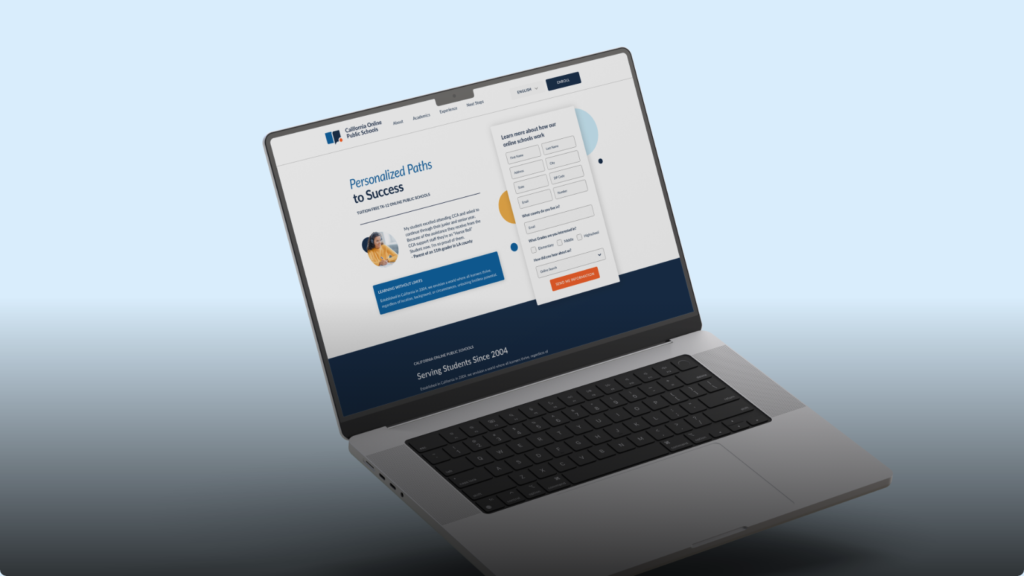
PORTFOLIO · ONLINE CHARTER SCHOOL
California Online Public Schools
1,500+ leads a month and 118x ROAS
View Project

Want an advertising plan that fills your next lottery? Book your free consultation.
Sources
- 20 U.S.C. 7221i, Definitions (charter school), https://www.law.cornell.edu/uscode/text/20/7221i
- Pew Research Center, Americans’ Social Media Use 2025 (Nov 20, 2025), https://www.pewresearch.org/internet/2025/11/20/americans-social-media-use-2025/
- Niche, Your mid-cycle pulse check: Real-time insights on K-12 parent search (Oct 31, 2024; 377 parent and guardian responses), https://www.niche.com/about/enrollment-insights/2024-niche-k-12-parent-survey/
- Google Advertising Policies Help, Personalized advertising, https://support.google.com/adspolicy/answer/143465
- Google Analytics Help, Campaign URL Builder, https://support.google.com/analytics/answer/10917952
- U.S. Department of Education, Student Privacy Policy Office, FERPA, https://studentprivacy.ed.gov/ferpa
- Brandastic case study: California Online Public Schools
By Justin Nassie, President and Founder of Brandastic. Brandastic is a Costa Mesa, California digital marketing agency founded in 2010 that has worked with 450+ brands and is a Google and Microsoft Partner. Last updated November 14, 2026.


