


Quick answer: Online charter school marketing works when it explains the model before it sells it. Parents need to see how a school day runs, how often students meet teachers live, what the parent role is and how testing works. Target ads only where students are legally eligible to enroll, answer those questions on landing pages, and follow up fast, because families compare several online options at once.
Key takeaways
- NCES counted 562,659 students in U.S. public virtual schools in 2022-23, down from 590,267 in 2020-21 but well above 293,689 in 2019-20.
- NEPC found that one third of full-time virtual schools (33.3%) were charters in 2021-22, but they enrolled 58.4% of virtual school students.
- Enrollment boundaries are set by state law. In California, independent study attendance can be claimed only for students who live in the county or an adjacent county, so ads should target only those areas.
- California also bars a charter from claiming independent study funding if it gives families funds or other things of value a district could not legally provide. Check enrollment incentives with counsel.
- Online public schools are tuition-free under the federal charter definition. Lead with fit, support and proof, not price.
What is online charter school marketing?
Online charter school marketing is the work of helping families find, understand and enroll in a tuition-free public school that teaches students mostly or entirely online. It differs from classroom charter marketing because there is no building to tour, enrollment areas can span a county or state, and many parents have never seen virtual school up close.
Online public schools are a real share of the market. NCES counted 562,659 students in public virtual schools in 2022-23, compared with 293,689 in 2019-20 (NCES, Table 216.20). The National Education Policy Center found 726 full-time virtual schools in 2021-22, and while charters made up one third of them, they enrolled 58.4% of virtual school students (NEPC, Virtual Schools in the U.S. 2023). Most of that enrollment sits in a small number of large schools: NEPC reports that schools run by education management organizations made up 32% of full-time virtual schools but enrolled 52% of their students.
That means a smaller online charter competes with large, well-funded brands for the same searches. This guide shows how to win anyway, with a clear explanation of your model, tight geographic targeting, strong proof and fast follow-up.
Why is marketing a virtual charter school different?
Marketing a virtual charter school is different because parents are buying into a way of learning, not a building. They worry about screen time, socialization, how much they must teach, and whether online school counts as real school. Your marketing has to answer those doubts with specifics, while targeting only families who live where your charter can legally enroll.
Four differences shape the plan:
- No campus tour. The website, info sessions and sample lessons do the job a tour does for a classroom school.
- A larger, legally defined area. Your enrollment boundary might be a county, a group of counties or a state, depending on your charter and state law.
- Year-round enrollment. Many online schools enroll at semester breaks and mid-year, not only in spring. Families often switch after a hard first semester somewhere else.
- Comparison shopping. Parents searching online school options usually look at several providers at once, so speed and clarity win.
Who are online public school families?
Online public school families usually include students who need flexibility: young athletes and performers, students with health needs, students who were bullied or struggled socially, families who move or travel, students who want to work ahead or catch up, and parents who want more involvement. Map your real families into a few groups and write to each one.
Do not guess. Pull the reasons families gave on their applications or exit surveys, and ask your enrollment team which questions come up most on calls. Then build one landing page and ad set per group, such as “flexible schedule for student athletes” or “a safe fresh start mid-year.” Each page should show how your school handles that family’s specific worry.
What do parents need to know before choosing an online charter school?
Before choosing an online charter school, parents need plain answers on how a typical day works, how many hours are live with a teacher, what the parent or learning coach does, what devices are provided, how special education works, how state testing happens, and whether students can join clubs or meet in person. Put these answers on one page.
A strong “How it works” page includes:
| Question parents ask | What your page should show |
|---|---|
| — | — |
| What does a school day look like? | A sample daily schedule by grade band |
| How much time with teachers? | Live class hours per week and how to reach a teacher |
| What is my role as a parent? | The learning coach role in plain terms, by grade |
| What do we need at home? | Devices, internet support and what the school provides |
| Is it really free? | Tuition-free public school, with any optional costs explained |
| What about friends and activities? | Clubs, field trips, in-person events and their frequency |
| How does testing work? | Where and when state tests happen |
| What support is there for my child’s needs? | Special education, English learner and counseling services |
Federal law defines a charter school as one that “does not charge tuition” (20 U.S.C. 7221i). Say “tuition-free public school” in your headline and meta description, because many parents assume online schools cost money. Our charter and online school marketing case study shows how a California online public school explained its model to parents.
How should online charter schools target ads?
Online charter schools should target ads only to the areas where students are legally eligible to enroll, and exclude everywhere else. Google Ads lets you target specific geographic locations, so build your targeting from your charter’s enrollment rules, not from where interest is highest. Ads that reach ineligible families waste budget and frustrate parents.
State law decides the boundary. In California, for example, independent study attendance can be claimed only for students who are residents of the county where the claim is reported or a county immediately adjacent to it (Cal. Educ. Code 51747.3). Other states use statewide or district boundaries. Practical steps:
- Write down the eligible area from your charter and state rules, and confirm it with your authorizer or counsel.
- Target those counties or the state in Google Ads and Meta, and exclude neighboring areas (Google Ads Help).
- Check location settings. Google offers broad targeting that includes people who have shown interest in a location. For enrollment, prefer reaching people who are in the eligible area.
- Ask for the ZIP code first on the inquiry form, and tell ineligible families kindly that they are outside your area.
- Split campaigns by region if your area is large, so you can shift budget toward places with more qualified inquiries.
See our guide to Google Ads for schools for campaign structure, and our post on Facebook and Instagram ads for schools for social audiences and creative.
What content works best for virtual school marketing?
The content that works best for virtual school marketing shows the experience: short videos of a live class, a day-in-the-life with a real student and parent, teacher introductions, sample lessons, and plain answers to common doubts. Because families cannot walk the halls, video and live info sessions replace the campus tour and carry most of the trust.
Build a content set that covers the whole decision:
- Sample lesson or class clip with permission from families, showing how students interact with the teacher.
- Parent stories by family type, such as the athlete, the student who needed a fresh start and the family that travels.
- Weekly live info sessions with time for questions, recorded for families who cannot attend.
- An honest FAQ on screen time, socialization and the parent’s role.
- YouTube explainers that answer search questions. Our post on YouTube for schools covers format and setup.
Get written permission before using any student’s image or voice, and treat student records under FERPA rules (U.S. Department of Education).
How should online charter schools follow up with inquiries?
Online charter schools should follow up within minutes, by text and phone, during the hours parents actually respond. Families comparing virtual options often fill out several forms at once, so the first school to answer their questions and book an info session or enrollment call usually has the advantage. Track every step so nobody falls through.
A simple follow-up sequence:
- Within five minutes: an automatic text and email with a link to book a call or info session.
- Same day: a personal call from an enrollment advisor.
- Days 2 to 7: short messages that answer the top doubts, with a parent story and a sample day.
- Before deadlines: reminders about semester start dates and required documents.
- After enrollment: onboarding messages, device delivery updates and a first-week check-in to prevent early drop-off.
Our posts on school inquiry response time, text message marketing for schools and choosing a school admissions CRM show how to set this up.
What rules should online charter school marketing follow?
Online charter school marketing should follow state enrollment boundary rules, avoid incentives that could break funding rules, use accurate claims about results and services, protect student privacy, and keep the website accessible. Rules vary by state, so review campaigns with your authorizer or counsel, especially offers, testimonials and anything that mentions outcomes.
Key points to check:
- Incentives. California says a charter may not claim independent study funding if it gave a pupil or parent funds or other things of value that a school district could not legally provide to a similar pupil, while connectivity and school-owned devices needed for the program are not counted as things of value (Cal. Educ. Code 51747.3). Avoid gift cards or prizes for enrolling unless counsel approves.
- Accuracy. Use dated, sourced numbers for any results you cite, and do not imply services you do not provide.
- Accessibility. The U.S. Department of Justice rule under ADA Title II sets WCAG 2.1 Level AA as the standard for state and local government web content, and lists public schools among covered entities (ADA.gov). An April 2026 rule moved compliance dates to April 26, 2027 for entities serving 50,000 or more people and April 26, 2028 for smaller ones (Federal Register). Our post on school website accessibility explains what to fix.
- Privacy. Get consent for student photos and stories, and keep student records out of ad platforms.
How should online charter schools measure marketing?
Online charter schools should measure the full path: inquiries from eligible areas, info session attendance, started and completed applications, enrolled students, students active after the first weeks, and students who stay through the year. Report by region and channel so budget follows families who enroll and stay, not just cheap leads.
Retention matters more for online schools than most, because families can switch quickly if the first weeks go badly. Add a “still active at week four” metric to your reports. Our guide to tracking ads to enrollment explains how to connect ad clicks to enrolled students.
How do online charter schools show up in AI search?
Online charter schools show up in AI answers when their website clearly states who can enroll, what grades they serve, that they are tuition-free, and how the program works, in plain sentences with FAQ sections. Consistent facts across the website, directories and state listings help AI tools describe the school correctly.
Parents increasingly ask AI tools to compare options such as “free online school in [county].” Write pages that answer those questions directly in the first two sentences. Our guide to AI search for schools covers the steps.
What can online charters borrow from college online programs?
Online charters can borrow a few habits from college online programs: speed-to-lead follow-up, clear program pages built for comparison, and multiple start dates promoted well ahead of time. The main difference is that K-12 online charters are tuition-free public schools with legal enrollment boundaries, so price messaging and national targeting do not apply.
Our post on online program marketing covers the college side for readers who work across both.
What mistakes should online charter schools avoid?
The most common online charter school marketing mistakes are targeting families outside the legal enrollment area, hiding how the school day works, using stock photos instead of real classes, slow follow-up, and measuring leads instead of enrolled and active students. Each one wastes spending or loses families who would have been a good fit.
- Running statewide ads when your charter can enroll only from certain counties.
- Leading with “free” alone, without explaining the experience.
- Offering prizes or gift cards for enrolling without checking state funding rules.
- Treating spring as the only enrollment season and ignoring mid-year switchers.
- Letting new families drift in the first month without a check-in.
To compare partners, see our guide to the best charter school marketing agencies.
Channels Brandastic manages
Brandastic plans and runs these channels for colleges and schools:
Every engagement starts with a first-month discovery and strategy phase. A strong strategy is what makes the campaigns work, so before anything launches we:
- Study your market and the schools you compete with for families.
- Define your ideal target families.
- Identify the parents, students and influencers to market to and what they care about.
- Build a communication plan: what to say, on which channels, and when.
- Pin down your school’s pain points, such as low inquiries or weak follow-up, and plan how to solve them.
- Decide whether to market locally, nationally or both.
For an example of results at scale, Brandastic’s enrollment campaigns for California Online Public Schools produce 1,500+ leads a month and 118x ROAS.
About the author: Justin Nassie is the President and Founder of Brandastic, an Orange County digital marketing agency he has run for 16 years. He has taught advanced web at Chapman University and has also taught at UC Irvine (UCI).
Keep reading: What an education marketing agency does; Charter and online school marketing case study; Google Ads for schools; School inquiry response time; Track ads to enrollment.
Frequently asked questions
How do online charter schools get students?
They explain the model clearly, target ads only where students are eligible to enroll, run live info sessions, and follow up with families within minutes by text and phone.
Are online charter schools free?
Yes. Charter schools are public schools, and the federal definition says a charter school does not charge tuition. Explain any optional costs plainly on your website.
Can an online charter school advertise statewide?
Only if its charter and state law allow statewide enrollment. Some states limit enrollment to certain counties or districts, so match ad targeting to your legal enrollment area.
How many students attend virtual public schools?
NCES counted 562,659 students in public virtual schools in 2022-23, up from 293,689 in 2019-20.
Can online charter schools offer enrollment incentives?
Be careful. California bars a charter from claiming independent study funding if it gives families funds or things of value a district could not legally provide. Check your state rules with counsel.
When should online charter schools advertise?
Before each start date, not only in spring. Many families switch at semester breaks, so plan campaigns for both the fall and mid-year enrollment windows.
Does Brandastic market online public schools?
Yes. Brandastic runs enrollment campaigns for California Online Public Schools, which produce 1,500+ leads a month and 118x ROAS.
Our Work in Education
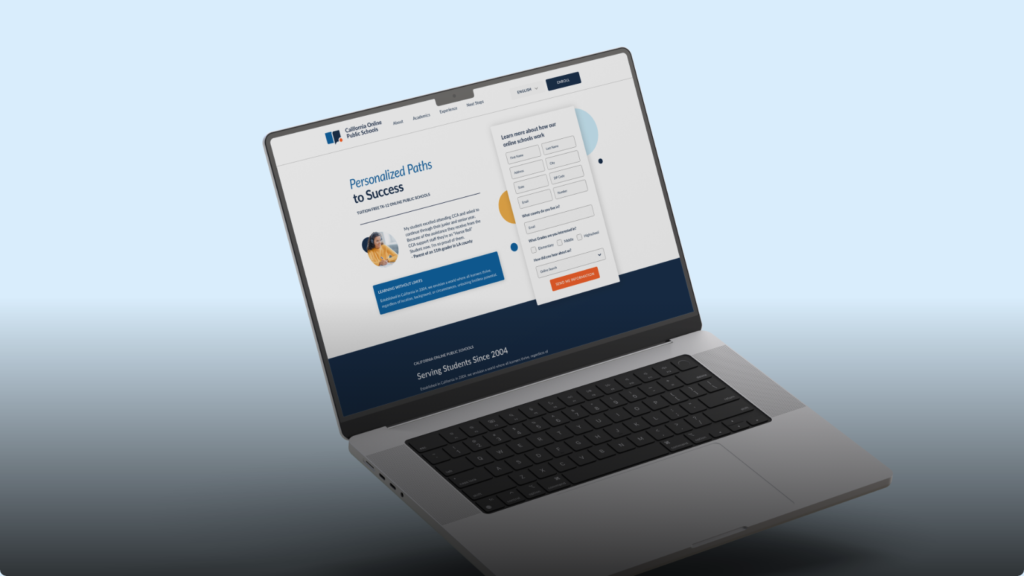
PORTFOLIO · ONLINE CHARTER SCHOOL
California Online Public Schools
1,500+ leads a month and 118x ROAS
View Project

Want a plan that helps parents understand your online school and enroll? Book your free consultation.
Sources
- NCES, Digest of Education Statistics, Table 216.20, enrollment by charter, magnet and virtual status (2012-13 through 2022-23), https://nces.ed.gov/programs/digest/d23/tables/dt23_216.20.asp
- National Education Policy Center, Virtual Schools in the U.S. 2023 (May 2023), https://nepc.colorado.edu/publication/virtual-schools-annual-2023; full report via ERIC, https://files.eric.ed.gov/fulltext/ED628827.pdf
- California Education Code Section 51747.3, leginfo.legislature.ca.gov
- 20 U.S.C. 7221i, Definitions (charter school), Cornell Legal Information Institute, https://www.law.cornell.edu/uscode/text/20/7221i
- Google Ads Help, Target ads to geographic locations, https://support.google.com/google-ads/answer/1722043?hl=en
- ADA.gov, Fact Sheet: New Rule on the Accessibility of Web Content and Mobile Apps Provided by State and Local Governments, https://www.ada.gov/resources/2024-03-08-web-rule/
- Federal Register, Extension of Compliance Dates for Nondiscrimination on the Basis of Disability; Accessibility of Web Information and Services of State and Local Government Entities (Apr. 20, 2026), federalregister.gov
- U.S. Department of Education, Student Privacy Policy Office, FERPA, https://studentprivacy.ed.gov/ferpa
- Brandastic case study: California Online Public Schools
By Justin Nassie, President and Founder of Brandastic. Brandastic is a Costa Mesa, California digital marketing agency founded in 2010 that has worked with 450+ brands and is a Google and Microsoft Partner. Last updated November 1, 2026.


