


Quick answer: AI search tends to favor big charter brands because AI answers lean on how often and how consistently a school is mentioned across the web, and large networks have far more mentions, pages and coverage. A smaller charter school catches up by publishing clear, specific answers about itself, keeping its facts identical everywhere, earning local mentions and reviews, completing its Google Business Profile and tracking where AI tools cite it.
Key takeaways
- In an Ahrefs study of 75,000 brands (May 2025), branded web mentions had the strongest correlation with AI Overview visibility (0.664), far above backlinks (0.218). Correlation is not causation.
- Brands in the top quartile for web mentions earned up to 10 times more AI Overview mentions than the next quartile, and 26% of brands had none (Ahrefs).
- Google says there are no extra technical requirements for AI Overviews or AI Mode: a page must be indexed and eligible for a snippet (Google Search Central).
- AI use for school research is still early for K-12: 4% of parents used AI search engines and 1% used AI chatbots in Niche’s October 2024 survey. It is growing faster in college search.
- A single campus usually cannot out-mention a national network, but it can win local, specific questions a network page answers vaguely.
- Consistency matters: the same name, address, grades, dates and “tuition-free” wording on your site, Google profile, state listings and directories.
Why does AI search favor big charter brands?
AI search favors big charter brands because the systems behind AI answers draw on what the web says about a school, and large networks are mentioned far more often. More pages, news coverage, directory listings, reviews and links give AI tools more evidence to cite and more confidence to recommend a familiar name.
The best public data on this comes from outside education. Ahrefs analyzed 75,000 brands and found that branded web mentions had the strongest correlation with visibility in Google’s AI Overviews, at 0.664, followed by branded anchors at 0.527 and branded search volume at 0.392. Backlinks were much weaker, at 0.218 (Ahrefs). Brands in the top quartile for web mentions earned up to 10 times more AI Overview mentions than the next quartile, and 26% of brands had no AI Overview mentions at all (Ahrefs).
Ahrefs is careful to say correlation is not causation, and the study covered brands in general, not schools. But the pattern matches what school leaders tell us: ask an AI assistant about charter schools in a big city and the answer often starts with the networks that have the most coverage.
How do AI search tools decide which schools to mention?
AI search tools mention schools they can find clear, consistent, trustworthy information about. Google says AI Overviews and AI Mode use the same foundations as regular search, and may issue several related searches, a technique it calls query fan-out, to build an answer with supporting links.
What Google has said directly (Google Search Central):
- The usual SEO best practices still apply to AI features.
- There are no additional technical requirements. A page must be indexed and eligible to appear in Search with a snippet.
- Meeting the requirements does not guarantee a page will be shown.
For local questions, Google Business Profile matters too. Google says local results are based mainly on relevance, distance and popularity (Google Business Profile Help). A complete, accurate profile with real reviews gives AI-powered local answers something solid to work with.
Other assistants, such as ChatGPT, Perplexity and Gemini, do not publish detailed ranking rules for schools. Treat them the same way: make your facts easy to find, easy to verify and identical everywhere.
Is AI search a big deal for charter school enrollment yet?
For K-12 enrollment, AI search is still small but growing, so it deserves steady attention rather than a large share of your budget. Most parents still find schools through search engines, word of mouth, events and school websites, but AI answers increasingly sit on top of those same searches.
The numbers we can verify:
- In Niche’s October 2024 survey of K-12 parents, 4% said they used AI search engines and 1% said they used AI chatbots to research schools (Niche).
- In EAB’s 2026 parent survey, 57% of parents of high school students said they used AI tools to evaluate colleges (EAB). College search is moving faster, and K-12 often follows.
- Pew Research Center found in 2025 that 34% of U.S. adults had used ChatGPT, about double the share in 2023 (Pew Research Center).
There is also a cross-over effect. The same work that helps AI tools understand your school, clear answers, consistent facts and strong local signals, also helps regular Google results and Google Business Profile. So the effort pays off even before AI search becomes a major channel.
Where can a small charter school beat a big network?
A small charter school can beat a big network on specific, local questions. A network’s pages often describe dozens of campuses in general terms, while a parent asks about one neighborhood, one grade or one program. Specific answers give AI tools something precise to cite.
Questions a single campus can own:
| Parent question | What to publish |
|---|---|
| — | — |
| “Free charter schools near [neighborhood]” | A page naming your neighborhood, grades, address and “tuition-free public charter school.” |
| “Bilingual charter school [city] kindergarten” | A program page describing your bilingual model, schedule and how to apply. |
| “Does [school] have busing?” | A transportation page with routes, stops or the plain answer “no, here is what we offer instead.” |
| “[School] lottery date” | A dated admissions page with this year’s deadline, lottery date and process. |
| “[School] special education support” | A page describing services and how to ask questions. |
| “Is [school] a good school?” | Sourced, dated results from your state report card, plus parent reviews. |
Networks have their own advantage: a large, well-known brand. Your advantage is closeness. Write like the front office talks.
What should a smaller charter school do first?
Start with the facts AI tools get wrong about you. Ask several assistants about your school and your area, write down what is wrong or missing, then fix those facts on your website, Google Business Profile and major listings before you create anything new.
A practical first month:
- Run an AI check. Ask ChatGPT, Gemini, Perplexity and Google AI Mode: “What are the best charter schools in [city]?”, “Is [school] free?” and “How do I apply to [school]?” Save the answers with the date.
- Fix the basics. Make your name, address, phone, grades served and “tuition-free public charter school” wording identical everywhere.
- Complete Google Business Profile. Categories, hours, photos, description and answers to common questions. See local SEO for schools.
- Publish an answer page. One page with short, direct answers to the ten questions parents ask most, with FAQ schema. Our guide to schema markup for schools covers the markup.
- Update admissions dates. AI answers with last year’s lottery date are a common and costly error.
How do you earn the mentions that big networks have?
Earn mentions by being useful and visible in your community, then making sure those mentions name you consistently. You will not match a national network’s volume, but local mentions on trusted sites, such as news outlets, partners and directories, carry real weight for local questions.
Sources of credible mentions:
- Local news. Share real stories: a new program, a student achievement, a community partnership.
- Community partners. Libraries, youth organizations and early learning centers that list your school on their sites.
- Directories and state listings. Your authorizer, your state’s school directory and reputable school-finder sites. Check that each one is accurate.
- Reviews. Ask families to leave honest reviews on Google and parent review sites. See our guide to school reviews from parents.
- Your own proof. Case studies, outcomes and family stories on your site, dated and sourced.
- Video. A YouTube channel with teacher and program videos gives AI tools another place to find you. See YouTube for schools.
Keep the wording the same each time: the full school name, city, grades and “tuition-free public charter school.” Consistency helps systems connect mentions to one school.
How do you measure AI search visibility for a charter school?
Measure AI visibility by checking the same set of questions on a schedule, tracking referral traffic from AI tools in analytics, and asking families how they heard about you. Expect small numbers at first, and watch the trend over several months rather than reacting to a single answer.
What to track:
- A fixed question set. The same 15 to 25 parent questions, asked monthly in several assistants, with notes on whether your school appears and whether the facts are right.
- AI referral traffic. Sessions from chatgpt.com, perplexity.ai, gemini.google.com and similar sources in Google Analytics.
- Google Search Console. Impressions and clicks for local and long questions.
- Self-reported source. Add “AI assistant such as ChatGPT” to your “How did you hear about us?” options.
- Applications. The outcome that matters, by source.
See how to measure AI search visibility before the click and school marketing attribution for setup details.
Should charter schools pay for AI ads instead?
Paid AI placements are separate from being mentioned in AI answers, and they do not buy recommendations. For example, OpenAI says ChatGPT ads do not influence answers, and its ad policy raises open questions for public schools. Build your organic presence first. Our post on ChatGPT ads for schools explains what is available and what is not.
How does this apply to colleges?
Colleges face the same pattern on a national scale: large, famous universities dominate generic AI answers, while smaller colleges win specific program and location questions. EAB’s 2026 survey shows parents of high school students are already using AI to evaluate colleges. The lesson for charter schools is the same: be the clearest answer to specific questions.
What mistakes should charter schools avoid?
- Assuming AI tools know your school is tuition-free and public.
- Leaving old lottery dates or grade levels on pages and listings.
- Using different school names or abbreviations across sites.
- Publishing vague pages that could describe any school.
- Buying links or fake reviews, which can hurt trust and break platform rules.
- Ignoring Google Business Profile.
- Judging AI work by one screenshot instead of a tracked question set over time.
For the broader picture, see AI search for schools and answer engine optimization (AEO).
Channels Brandastic manages
Brandastic plans and runs these channels for colleges and schools:
Every engagement starts with a first-month discovery and strategy phase. A strong strategy is what makes the campaigns work, so before anything launches we:
- Study your market and the schools you compete with for families.
- Define your ideal target families.
- Identify the parents, students and influencers to market to and what they care about.
- Build a communication plan: what to say, on which channels, and when.
- Pin down your school’s pain points, such as low inquiries or weak follow-up, and plan how to solve them.
- Decide whether to market locally, nationally or both.
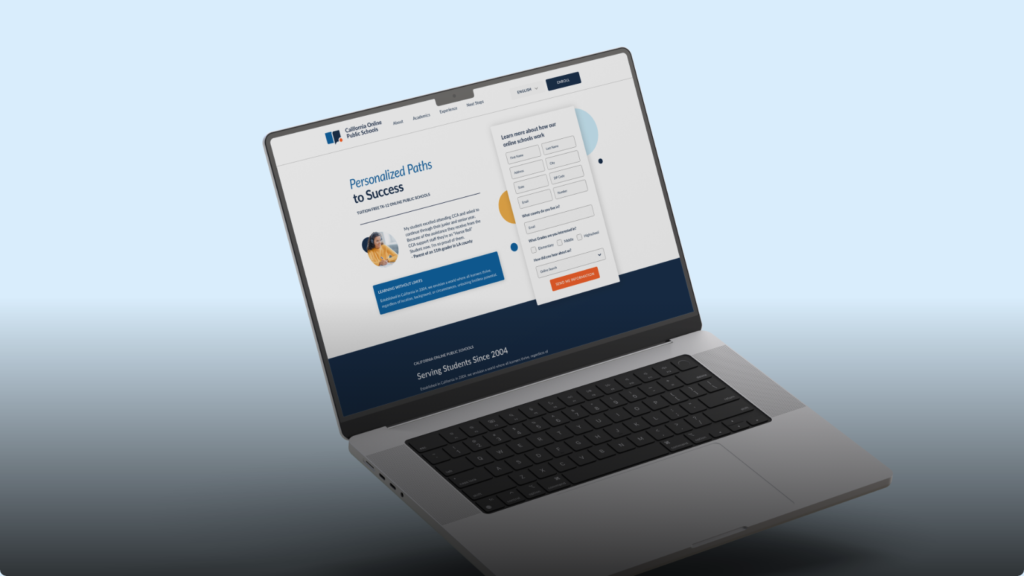
For an example of results at scale, Brandastic’s enrollment campaigns for California Online Public Schools produce 1,500+ leads a month and 118x ROAS.
About the author: Justin Nassie is the President and Founder of Brandastic, an Orange County digital marketing agency he has run for 16 years. He has taught advanced web at Chapman University and has also taught at UC Irvine (UCI).
Keep reading: What an education marketing agency does; AI search for schools; Answer engine optimization (AEO); AI for school marketing; Best charter school marketing agencies; What makes content citable in an AI search world.
Frequently asked questions
Why does AI search recommend big charter networks?
Large networks have far more web mentions, pages and coverage. In an Ahrefs study of 75,000 brands, web mentions correlated most strongly with AI Overview visibility.
Can a small charter school show up in AI answers?
Yes, especially for specific local questions. Publish clear answers about your grades, programs, dates and location, and keep facts identical everywhere.
Does Google have special requirements for AI Overviews?
No. Google says a page must be indexed and eligible to show with a snippet. Regular SEO best practices apply, and nothing guarantees inclusion.
How many parents use AI to choose a K-12 school?
In Niche’s October 2024 survey, 4% of K-12 parents used AI search engines and 1% used AI chatbots to research schools. Use is higher in college search.
What is the first step for AI visibility?
Ask several AI assistants about your school, list what is wrong or missing, and fix those facts on your site, Google Business Profile and listings.
Do reviews help a charter school in AI search?
Reviews help local visibility, and Google says local results rely mainly on relevance, distance and popularity. Ask families for honest reviews, never fake them.
Can I pay to be recommended by ChatGPT?
No. OpenAI says ChatGPT ads do not influence answers. Being recommended depends on your content, reputation and consistency.
Does Brandastic help charter schools with AI search?
Yes. Brandastic runs SEO and answer engine optimization for schools, including AI visibility checks and local search work.
Our Work in Education
PORTFOLIO · ONLINE CHARTER SCHOOL
California Online Public Schools
1,500+ leads a month and 118x ROAS
View Project

Want AI search to name your school, not just the big networks? Book your free consultation.
Sources
- Ahrefs, An Analysis of AI Overview Brand Visibility Factors (75K Brands Studied) (May 26, 2025), https://ahrefs.com/blog/ai-overview-brand-correlation/
- Google Search Central, AI features and your website, https://developers.google.com/search/docs/appearance/ai-features
- Google Business Profile Help, Tips to improve your local ranking on Google, https://support.google.com/business/answer/7091
- Niche, Your mid-cycle pulse check: Real-time insights on K-12 parent search (Oct. 31, 2024), https://www.niche.com/about/enrollment-insights/2024-niche-k-12-parent-survey/
- EAB, More than Half of Parents Use AI to Research Colleges (Aug. 3, 2026), https://eab.com/about/newsroom/press/2026-parent-survey/
- Pew Research Center, 34% of U.S. adults have used ChatGPT (June 25, 2025), https://www.pewresearch.org/short-reads/2025/06/25/34-of-us-adults-have-used-chatgpt-about-double-the-share-in-2023/
- Brandastic case study: California Online Public Schools
By Justin Nassie, President and Founder of Brandastic. Brandastic is a Costa Mesa, California digital marketing agency founded in 2010 that has worked with 450+ brands and is a Google and Microsoft Partner. Last updated November 5, 2026.


