


Quick answer: Higher education SEO is the work of getting a college’s program, admissions and cost pages to show up when prospective students search, and now when they ask AI tools. Start with program pages that answer real questions, a fast mobile site, clean technical structure and local signals for each campus. Hire a higher education SEO agency when you need a team to audit, prioritize and report on applications, not just rankings.
Key takeaways
- 42% of college-bound students find college websites through a search engine; 11% use AI tools (RNL, 2025).
- Students most want a list of programs (57%), financial aid information (49%) and details on a specific program (46%).
- 96.55% of pages get no traffic from Google (Ahrefs), so pages need to answer specific searches to earn visits.
- Program pages, page speed and clear structure usually matter more than blog volume.
- Judge an SEO agency by applications and starts from organic search, not rankings alone.
What is higher education SEO?
Higher education SEO (search engine optimization) is the ongoing work of making a college or university’s website easy for search engines and AI tools to find, understand and recommend for the searches prospective students make. It covers program pages, admissions and cost content, site speed and structure, local listings for each campus, and links from other trusted sites.
It matters because search is still one of the main ways students find colleges. In Ruffalo Noel Levitz’s 2025 E-Expectations report, 42% of college-bound high school students said they find college websites through a search engine, 54% through email and 11% through AI tools such as ChatGPT or Perplexity (RNL). Adult and graduate students, who often start with a program name rather than a college name, lean on search even more.
What do students search for?
Students rarely search for your college’s name first. They search for a program (“online MBA California”), an outcome (“nursing degree with clinical placement”), a cost question (“how much is community college in Orange County”) or a format (“evening classes for working adults”). RNL found the content students want most on college websites is a list of programs (57%), scholarship and financial aid information (49%) and details about a specific program (46%), followed by cost (39%). One in four said it was hard to find information about specific majors or programs.
That tells you where SEO effort should go first: the pages that answer program, cost and admissions questions.
Where should a college start with SEO?
1. Build a strong page for every program
Each program needs its own page with a clear title, what students learn, format and length, start dates, admission requirements, cost and aid, career outcomes and a way to ask a question. Thin program pages that only list courses rarely rank. Ahrefs found that 96.55% of pages in its index get no traffic from Google (Ahrefs), usually because they do not match what people search for or have no links pointing to them.
2. Fix speed and mobile experience
Most students browse on phones. Google’s Core Web Vitals define a good experience as a Largest Contentful Paint within 2.5 seconds, Interaction to Next Paint of 200 milliseconds or less and Cumulative Layout Shift of 0.1 or less (web.dev). Heavy sliders, autoplay video and large images often push college sites past these thresholds.
3. Clean up structure
College sites grow for years across departments, so they collect duplicate pages, broken links, old PDFs and confusing navigation. A technical audit should find pages that compete with each other, pages that cannot be crawled and redirects that break. Google’s own SEO starter guide stresses descriptive titles, a logical site structure and helpful, people-first content.
4. Claim every campus listing
Each campus should have an accurate Google Business Profile with hours, photos and reviews. Google says local results are based mainly on relevance, distance and prominence (Google Business Profile Help). Community colleges and multi-campus systems gain the most here.
5. Answer questions clearly for AI search
AI tools pull from pages that answer questions directly. Put a short, plain answer at the top of key pages, use question headings and keep facts such as deadlines and tuition current. Our guide to AI search for schools covers this in more detail.
How does AI search change higher education SEO?
AI answers do not replace SEO; they raise the bar for it. Google says its AI features draw on the same core ranking systems as regular search, and that pages need to be indexed and eligible to show a snippet to appear as a supporting link (Google Search Central). In practice, pages that rank well and answer questions clearly are the pages AI tools cite.
Use is growing quickly. Pew Research Center found 34% of U.S. adults had used ChatGPT by early 2025, about double the share in 2023, including 58% of adults under 30 (Pew). For colleges, that means checking how AI tools describe your programs and fixing pages that give outdated or vague information.
What does a higher education SEO agency do?
A good higher education SEO agency will:
- Audit your site for technical issues, duplicate content and speed problems.
- Research the searches students make for each program and map them to pages.
- Rewrite or expand program, admissions and cost pages.
- Fix structure, internal links and schema markup.
- Build local listings for each campus.
- Earn links and mentions from relevant sites.
- Track organic traffic to inquiries, applications and starts, not just rankings.
Some agencies only do SEO. Others combine SEO with paid search, social and web development, which helps when your site needs both content and technical changes. If you are deciding between types of firms, see our guide to higher education marketing companies.
How should a college choose an SEO agency?
| Factor | What to ask | What good looks like |
|---|---|---|
| Higher ed experience | Which colleges or programs have you worked on? | Examples with organic inquiry or application growth |
| Reporting | What do you report monthly? | Organic inquiries, applications and starts by program |
| Technical depth | Who handles technical fixes? | A clear plan with your web team or theirs |
| Content | Who writes program pages? | Writers who interview faculty and admissions |
| AI search | How do you plan for AI answers? | A method to check and improve how AI tools describe you |
| Terms | What do we own? | Your content, analytics and accounts |
Be wary of anyone who guarantees a number-one ranking or promises results in weeks. SEO usually takes months, and no one controls Google’s results.
What are common higher education SEO mistakes?
- One page for many programs. A single “Academics” page cannot rank for dozens of program searches.
- Department sites that compete. Several pages targeting the same program split authority. Merge or redirect them.
- Key facts in PDFs. Tuition, requirements and catalogs locked in PDFs are harder for students and search engines to use.
- Redesigns without redirects. Changing URLs without 301 redirects can erase years of rankings.
- Measuring traffic, not inquiries. Visits that never become inquiries do not fill classes.
How long does higher education SEO take?
Technical fixes can show results within weeks once Google recrawls your site. New or rewritten program pages usually take a few months to rank, and competitive programs such as nursing, business and online degrees can take longer. Plan for a 6- to 12-month horizon and track progress monthly by program.
How do you measure SEO for a college?
Rankings and traffic are early signals. The real measures are inquiries, applications and enrollments from organic search, by program. Set up conversion tracking on inquiry and application forms, tag sources in your CRM and report cost per start across channels so SEO can be compared with paid search and social. Our post on tracking which ads lead to enrolled students explains the setup, and the same approach works for organic.
How does SEO fit with the rest of college marketing?
SEO works best alongside email, paid search and social. Paid search fills gaps while organic pages build, and data from paid campaigns shows which program keywords convert. For the full picture, see higher education marketing strategies and digital marketing in higher education.
Channels Brandastic manages
Brandastic plans and runs these channels for colleges and schools:
Every engagement starts with a first-month discovery and strategy phase. A strong strategy is what makes the campaigns work, so before anything launches we:
- Study your market and the colleges you compete with for students.
- Define your ideal target students.
- Identify the students, adult learners, parents and influencers to market to and what they care about.
- Build a communication plan: what to say, on which channels, and when.
- Pin down your college’s pain points, such as low inquiries or weak follow-up, and plan how to solve them.
- Decide whether to market locally, nationally or both.
For an example of results at scale, Brandastic’s enrollment campaigns for California Online Public Schools produce 1,500+ leads a month and a 118x return on ad spend (ROAS).
About the author: Justin Nassie is the President and Founder of Brandastic, an Orange County digital marketing agency he has run for 16 years. He has taught advanced web at Chapman University and has also taught at UC Irvine (UCI).
Keep reading: What an education marketing agency does; Best higher education digital marketing agencies; AI search for schools; Digital marketing in higher education.
Frequently asked questions
What is higher education SEO?
It is the work of making a college website easy for search engines and AI tools to find, understand and recommend for the searches prospective students make, especially program, cost and admissions searches.
How do college students find college websites?
In RNL’s 2025 report, 54% found college websites through email, 42% through a search engine and 11% through AI tools.
What pages matter most for college SEO?
Program pages, admissions and cost pages and campus pages. Students most want program lists, financial aid information and specific program details.
How long does SEO take for a college?
Technical fixes can help within weeks. New program pages usually take a few months to rank, and competitive programs can take longer. Plan for 6 to 12 months.
Should a college hire an SEO agency?
Hire one if you lack staff to audit, write program content and fix technical issues, or if you need reporting tied to applications and starts.
Does SEO help with AI search?
Yes. Google says its AI features rely on its core ranking systems, so pages that rank and answer questions clearly are more likely to be cited.
Does Brandastic do higher education SEO?
Yes. Brandastic runs SEO and AI search work alongside paid search, social and web for colleges and schools.
See how our higher education marketing agency services work.
Our Work in Education
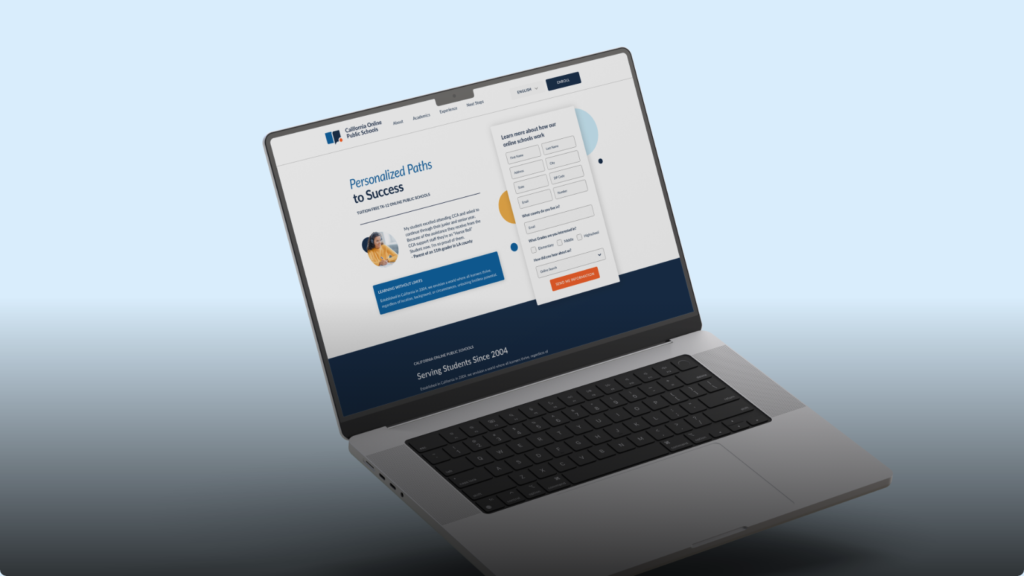
PORTFOLIO · ONLINE CHARTER SCHOOL
California Online Public Schools
1,500+ leads a month and 118x ROAS
View Project

Want more students finding your programs in search? Book your free consultation.
Sources
- Ruffalo Noel Levitz (RNL), 2025 E-Expectations Trend Report, https://learn.ruffalonl.com/rs/395-EOG-977/images/2025_E-Expectations_Report.pdf
- Ahrefs, 96.55% of Content Gets No Traffic From Google, https://ahrefs.com/blog/search-traffic-study/
- web.dev, Web Vitals, https://web.dev/articles/vitals
- Google Search Central, SEO Starter Guide, https://developers.google.com/search/docs/fundamentals/seo-starter-guide
- Google Search Central, AI features and your website, https://developers.google.com/search/docs/appearance/ai-features
- Google Business Profile Help, Tips to improve your local ranking on Google, https://support.google.com/business/answer/7091
- Pew Research Center, 34% of U.S. adults have used ChatGPT, about double the share in 2023 (Jun 25, 2025), https://www.pewresearch.org/short-reads/2025/06/25/34-of-us-adults-have-used-chatgpt-about-double-the-share-in-2023/
By Justin Nassie, President and Founder of Brandastic. Brandastic is a Costa Mesa, California digital marketing agency founded in 2010 that has worked with 450+ brands and is a Google and Microsoft Partner. Last updated December 2, 2026.


