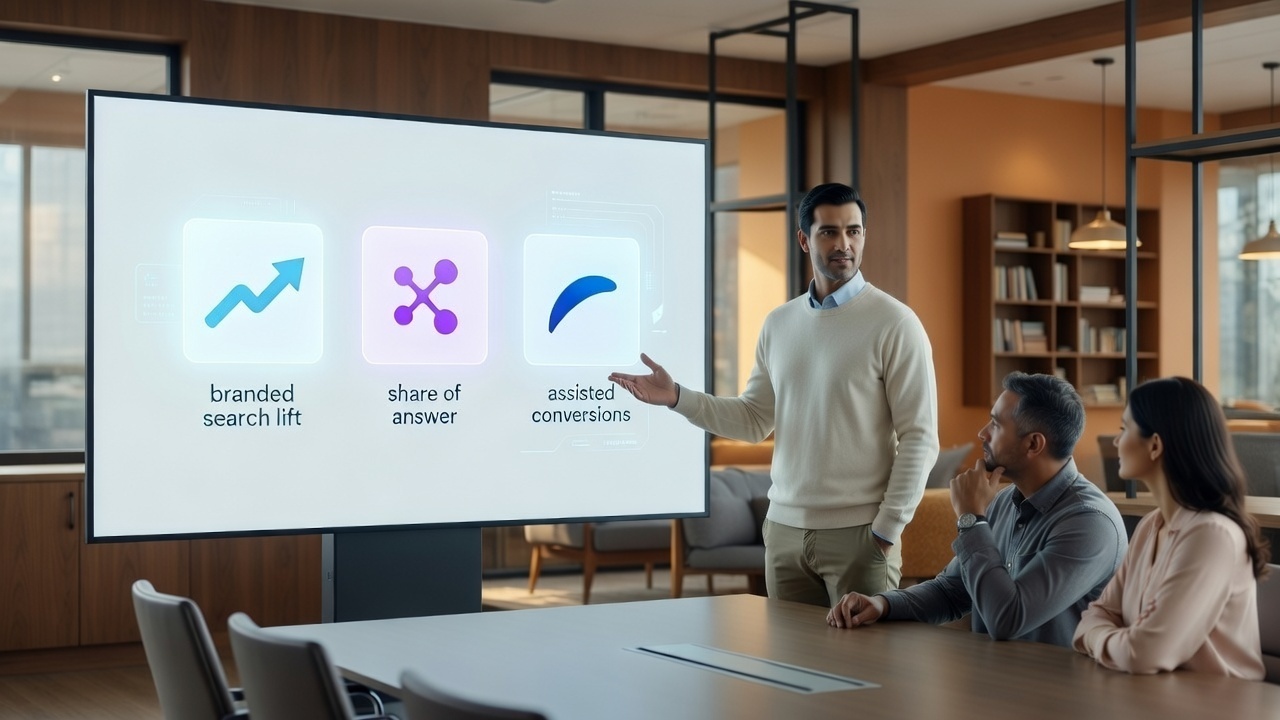

Executives do not need another screenshot of ChatGPT naming the brand.
They need a scoreboard.
AI citation reporting fails in most companies for a simple reason: marketing tracks mentions like trophies, while leadership tracks money, risk, and momentum. Screenshots feel busy. They do not answer Are we winning the shortlist? Is demand moving? Are deals getting easier?
This post is a reporting playbook. It turns AI visibility KPIs into a language finance and sales can use—share of answer, AI search metrics, branded search lift, lead quality, sales-cycle influence, and assisted conversions—without pretending every mention is a session in Google Analytics.
For the pre-click measurement system behind this, start with how to measure AI search visibility before the click. Here the focus is what leadership should see each month.
Why Classic SEO Reports Undercount AI
Traditional search reporting assumes a clean path: impression → click → session → conversion
AI answers break that path.
A buyer can:
- See your brand in an answer and never click
- Click a competitor the model listed beside you
- Search your name two days later
- Tell sales “ChatGPT recommended you” while last-click credit goes to paid search
So AI search visibility is not the same as organic traffic. If the only AI line in the deck is “AI referral sessions,” you will look small even when influence is real. Google rankings do not guarantee AI citations either—which means rank charts alone cannot stand in for citation performance. Executives need a ladder: exposure → accuracy → demand → pipeline.
The Executive Ladder: Six KPI Groups That Matter
Use these sections in the monthly deck. Keep each section to one slide when possible.
1. Citation frequency (are we present?)
Definition: How often the brand is named or linked inside AI answers for a fixed prompt set.
How to run it:
- Lock 20-40 buying prompts (not trivia)
- Check the same tools each cycle: ChatGPT, Perplexity, Gemini, Copilot, Google AI Overviews where relevant
- Score: named / cited as source / absent
- Trend month over month on the same prompt list
Executive question it answers: Are we in the room when buyers ask AI for options?
Watch-outs: Do not inflate the list with vanity prompts. “What is digital marketing?” is not a money query.
2. Share of answers (are we winning the shortlist?)
Definition: Your brand’s presence relative to named competitors inside the same answers.
Simple formula:
For each prompt: brands named in the answer ÷ whether you are one of them. Roll up to % of prompts where you appear, and average position in the shortlist when ranked.
Executive question: When AI builds a shortlist in our category, how often are we on it—and who is beating us?
Share of answer is the Ai cousin of share of voice. It is one of the cleanest AI visibility KPIs for leadership because it is competitive by design. Pair it with work on winning visibility in AI answers.
3. Citation accuracy (are we described correctly?)
Definition: Whether the model’s description of you matches the positioning you want—specialty, geo, offer, proof, and caveats.
Track a simple accuracy grade per prompt:
| Grade | Meaning |
| Green | Specialty and facts match |
| Yellow | Named, but vague or partly wrong |
| Red | Mispositioned, outdated, or harmful error |
Executive question: If a buyer only remembers the AI summary, did we help or hurt ourselves?
Accuracy turns “we got mentioned” into brand risk management. Wrong citations are not vanity wins.
4. Branded search lift (did curiosity become demand?)
Definition: Movement in branded query volume and branded CTR after citation programs, launches, or PR—the classic lagging signal that people heard the name somewhere and came to validate.
AI search metrics that pair well here:
- Branded impressions and clicks in Search Console
- Direct traffic (noisy, still directional)
- “How did you hear about us?” with an AI-tool option
Executive question: Are mentions creating people who look for us by name?
This is often where the money hides when referral clicks stay low. Call it branded search lift, not “brand vibes.”
5. AI referral and on-site behavior (when the click does come)
Definition: Sessions and conversions from known AI referrers, plus quality of those visits.
Set up referrer tracking properly (track AI-referred traffic in GA4). Report:
- Sessions from AI tools
- Engagement rate / key events
- Conversion rate vs. organic baseline
- Landing pages that receive AI traffic
Executive question: When AI sends a visit, is it tire-kicking or buyer-ready?
Volume may be small. Quality often is not. Say both out loud so leadership does not kill the channel for low session count.
6. Pipeline influence (assisted conversions and sales reality)
Definition: Revenue and opportunity impact that helped start or speed up—even when AI was not last click.
Include:
- Assisted conversion where AI referrers or branded search appear in the path
- CRM notes and intake fields that name ChatGPT, Perplexity, Gemini, Copilot, etc.
- Lead quality: fit, meeting rate, win rate, average deal size vs. other inbound
- Sales-cycle length on deals where the buyer already arrived with your name
- Win/loss notes: “made shortlist because AI named us” vs. “lost to a competitor AI preferred”
Executive question: Is this making pipeline better, faster, or larger—or only making marketing decks longer?
This is the bridge from AI visibility into leads and real commercial outcomes.
A One-Page Executive Scoreboard
| Layer | KPI | Target style | Owner |
| Exposure | Citation frequency on money prompts | Trend ↑ on fixed list | SEO / AEO |
| Competition | Share of answer vs. 2-3 rivals | Trend ↑ / gap ↓ | SEO / AEO |
| Brand risk | % green accuracy grades | Trend ↑; red = fix now | Brand + content |
| Demand | Branded search lift | MoM / YoY context | SEO + analytics |
| Direct proof | AI referral CVR vs. organic | Qualify, don’t only count | Analytics |
| Money | Assisted conversions + CRM AI source + cycle lifetime | Narrative + numbers | Marketing ops + sales |
If the deck cannot fill the Money row, the program is still in pilot mode. Say that honestly. Executives respect a pilot with gates more than inflated “AI wins.”
How to Collect the Data Without a Fantasy Tech Stack
You do not need a perfect platform on day one.
Prompt panel (weekly or biweekly)
Spreadsheet or lightweight tool. Same prompts. Same tools. Date-stamped. Screenshot only as evidence packs for sales—not as the KPI itself.
Search Console + analytics
Branded queries, landing pages, AI channel group. Keep SEO fundamentals healthy so branded validation converts when demand arrives.
CRM and forms
Add “AI tool / ChatGPT / Perplexity / Gemini / other assistant” to every meaningful intake. Train SDRs to ask one discovery question: Did you use an AI tool while researching us?
Sales One-Pager
Live citations, the prompts you win, and the specialty language models repeat. If sales never sees it, influence never gets logged.
Content and entity ops
Answer Engine Optimization (AEO) and content marketing supply the raw material models reuse. Measurement without source improvement is just watching the scoreboard go sideways. For getting into answers in the first place, see how to get your brand mentioned in AI answers.
This fits a wider AI marketing program: visibility, measurement, and conversion as one system—not a side experiment in the SEO channel.
What Good AI Citation Reporting Looks Like in a Leadership Meeting
A strong readout sounds like this:
- Prompt set: 30 commercial prompts. Unchanged for six months except documented adds.
- Share of answer: We appear on 14/30 (up from 9). Competitor A on 22/30.
- Accuracy: 11 green, 2 yellow, 1 red (red = wrong service geography—fix shipped).
- Branded search: +18% branded clicks vs. prior 28 days; note campaign overlap.
- AI referral: 4% of inbound sessions, 1.6x organic CVR on demo requests.
- Pipeline: 7 opportunities with AI noted in CRM; average cycle 9 days shorter on those deals; two closed-won assisted.
- Next bets: Three prompts we lose; two source pages to refresh; one comparison asset; sales enablement update.
That is AI citation reporting executives can govern. It connects mentions to competition, brand risk, demand, and money.
A weak readout sounds like: “We got cited a lot this month” plus ten screenshots. That is not a KPI system. That is a scrapbook—and it feeds the same visibility gap problem: exposure without a business decision.
Guardrails so the Numbers Stay Honest
- Fixed denominators. Changing the prompt list every month makes trends fake.
- Separate money prompts from education prompts. Report both if needed; never blend them into one vanity %.
- Do not force last-click purity. AI influence is often assisted. Say so.
- Annotate confounders. PR spikes, outages, product launches, and paid brand campaigns move branded search too.
- Cap screenshot theater. Evidence packs for sales; trends for executives.
- Tie red accuracy items to owners and dates. Unowned errors become permanent brand debt.
30-Day Standup Plan
Week 1: Build the money prompt list with sales. Add AI source field to forms. Create GA4 AI channel group.
Week 2: First full citation pass + accuracy grades + competitor share of answer.
Week 3: Wire branded search and AI referral into the existing marketing dashboard. Brief sales on current citations.
Week 4: First executive one-pager using the six KPI groups. Agree on two decisions: what to fund, what to ignore.
After 30 days, you will not have perfect attribution. You will have a governing system—which is what executives actually buy.
The Point of Measurement
AI citations are not an AEO side quest. They are early influence in how buyers shortlist vendors and products.
Make them measurable the same way you made SEO measurable: define the unit of work, track competition, connect demand, and bring pipeline into the room. Share of answer without revenue context is incomplete. Revenue claims without citation discipline are ungovernable.
If you want a clear baseline—prompt panel, Ai visibility KPIs, and where demand is leaking between mention and money—start with a free marketing audit.
Frequently Asked Questions
What is AI citation reporting?
AI citation reporting is the practice of tracking when and how AI systems name, describe, or source your brand, then connecting that exposure to demand and pipeline metrics executives care about—not only counting screenshots.
Which AI visibility KPIs should leadership see first?
Start with citation frequency on money prompts, share of answer vs. competitors, citation accuracy, branded search lift, AI referral conversion rate, and assisted conversions / CRM-noted AI influence. That set covers exposure, competition, brand risk, demand, and money.
What is share of answer?
Share of answer measures how often your brand appears in AI-generated answers for a fixed set of prompts relative to competitors. It is a competitive visibility metric for answer engines, similar in spirit to share of voice in search or media.
Why isn’t AI referral traffic enough?
Because many AI sessions never send a click. Buyers still form shortlists and later search the brand by name. Referral traffic is one proof path. It undercounts total influence if used alone.
How do assisted conversions fit AI search metrics?
Assisted conversions capture journeys where an AI referrer or AI-influenced branded visit appears in the path even if another channel gets last click. They help leadership see contribution without forcing a false last-click story.
How do we measure branded lift from AI citations?
Track branded query volume and clicks over time, annotate major citation or PR moments, and compare against baseline. Support with survey/CRM fields that name AI tools. Lift is directional evidence, not a perfect single-touch proof.
What is citation accuracy and why does it matter?
Citation accuracy is whether AI descriptions of your brand match the positioning and facts you intend. A frequent wrong citation can damage trust faster than silence. Grade accuracy and assign fixes.
How often should executives review these metrics?
Monthly is enough for most leadership forums, with a lighter biweekly ops check on the prompt panel. Weekly screenshot dumps create noise without decisions.
Do we need special software to start?
No. A locked prompt list, consistent manual or semi-automated checks, Search Console, analytics channel grouping, and CRM fields are enough to stand up credible AI citation reporting. Tools can come later once definitions are stable.
How is this different from standard SEO reporting?
SEO reporting centers on rankings, clicks, and on-site conversion from search. AI citation reporting adds answer-level presence, competitive shortlist share, pre-click influence, and assisted demand paths that never look like classic organic sessions.