Brands keep asking the same question in different clothes:
“Do we optimize for Google’s AI Overviews… or ChatGPT… or Perplexity… first?”
It sounds like a platform decision. It is really a priority decision.
AI search platforms do not reward the same page the same way. Google still sits on the open web and blends answers with blue links. ChatGPT often behaves like a research partner that may or may not show tidy source chips. Perplexity leans hard into cited answers and follow-up research. If you treat them as one “AI SEO” bucket, you will spend months polishing the wrong surface.
This post is a comparison you can hand to a client or leadership team: how each environment surfaces information, how it cites sources, how it shapes discovery—and where a practical GEO strategy should start.
For a bigger map of answer-layer work, see AEO vs. GEO vs. LLMO. Here the question is simpler: first bet, second bet, third bet.
The Short Answer (If You Only Have Two Minutes)
Optimize first for the system that already sits on your demand path—then expand.
| If your buyers mostly… | Start here | Why |
| Still begin research on Google | AI Overviews SEO + classic technical/content SEO | Highest overlap with existing organic demand; zero-click risk is real, but so it residual click + branded follow-up |
| Ask ChatGPT for shortlists, vendors, “best of,” and how-to framing | ChatGPT visibility (entity clarity + citable proof) | Shortlist formation happens before your site; presence beats perfect prose |
| Use Perplexity for sourced research and competitive scans | Perplexity SEO (clear pages + strong external corroboration) | Citation-heavy answers punish thin or contradictory sources |
| Split research across tools | Build a shared spine, then sequence | Same facts everywhere; different packaging per engine |
Most B2B and local service brands should not abandon Google to chase chat screenshots. They should harden the public record Google and models both read—then run a deliberate ChatGPT visibility and Perplexity SEO loop on the same commercial prompts.
That is search everywhere optimization without the panic.
What “Optimize” Means on AI Search Platforms
Classic SEO optimizes for rankings and clicks.
GEO strategy (generative engine optimization) optimizes for being understood, selected, and cited inside generated answers—even when the click never comes.
Across platforms, “good” still rests on the same spine:
- Entity clarity: who you are, who you serve, where you operate
- Offer clarity: what someone can buy
- Proof: case studies, reviews, process, credentials
- Consistency: same story on-site and across the open web
- Extractability: facts a system can lift without guessing
What changes is how the answer is assembled and what the user sees next.
That is why AI search visibility is not the same as organic traffic, and why Google rankings do not guarantee AI citations. Rank is one exam, Answer inclusion is another.
Platform 1: Google AI Overviews
How Information Surfaces
AI Overviews sits on top of (or inside) the Google results experience. The user still came to Google with a query. The Overview tries to answer early—often with a synthesized blurb and supporting links—while traditional results remain nearby.
This matters: AI Overviews SEO is not a separate intent. It is an answer layer on the same discovery habit most brands already pay to win.
How Sources and Citations Work
Overviews pulls from the open web and tend to favor pages that already look trustworthy in Google’s broader systems: clear topical focus, solid technical access, helpful structure, and corroboration. Links in or under the Overviews are a big deal because they are still Google-mediated discovery.
You are competing to be:
- Accurate enough to summarize
- Visible enough to cite
- Useful enough to keep as a click target when the user wants depth
How It Influences Discovery
Two effects at once:
- Zero-click compression: some research ends in the Overview
- Guided clicking: other users click the cited sources or related results with a pre-formed frame
If you are named or linked, you influence the frame. If you are absent, a competitor’s framing may become the default.
Where AI Overviews SEO Should Focus First
- Money pages that match commercial intent: services, locations, category explainers
- Technical eligibility: crawlable HTML, fast pages, clean structure, honest schema
- Answer-ready blocks: definitions, steps, FAQs, comparison tables users (and systems) can lift
- Earned corroboration: reviews, partners, reputable mentions that support the same claims
Do not treat Overview wins as a screenshot hobby. Tie them to the same prompt set you use for other engines, and measure with AI search visibility before the click.
Best first for: brands whose pipeline still starts with Google, local/service queries, and informational → commercial journeys on search.
Platform 2: ChatGPT
How Information Surfaces
ChatGPT is a conversation. Users ask multi-step questions, refine, and compare. Answers can sound like advice from a sharp generalist. Depending on mode and product surface, the model may browse, use tools, or lean more on training-time patterns plus whatever retrieval is available in that session.
ChatGPT visibility is less about “ranking #1” and more about:
- Being a stable entity the model can place in a category
- Having public proof that survives paraphrase
- Showing up when users ask for options, vendors, or “who should I talk to?”
How Sources and Citations Work
Citation behavior is inconsistent across products and settings. Sometimes you get clear links. Sometimes you get a confident shortlist with thin sourcing. That is exactly why brands feel gaslit: a mention can be powerful and still hard to attribute in analytics.
So optimize for being correctly describable, not only for a blue footnote.
How It Influences Discovery
ChatGPT often shapes the shortlist and the rubric:
- Which three brands “count”
- What “good” means in the category
- Which objections surface early
Buyers then validate on Google, your site, or sales—which is why citations still shape shortlists even when GA4 stays quiet. Track AI-assisted paths when clicks do appear (how to track AI-referred traffic in GA4), but do not pretend referral sessions equal total influence.
Where ChatGPT Visibility Work Should Focus First
- One plain-language positioning line repeated everywhere
- Service/product pages that state fit and proof without poetry fog
- Case studies with context (problem, approach, outcome range, constraints)
- Consistent NAP/category/service facts across site, profiles, and directories
- A locked prompt panel of real buying questions you re-check monthly
Chasing one viral prompt is a trap. See the problem with chasing AI prompt value. Durable fields beat lucky transcripts.
Best first for: categories where buyers ask chat tools for shortlists (agencies, software, professional services, complex B2B) and where sales already hears “ChatGPT mentioned you.”
Platform 3: Perplexity
How Information Surfaces
Perplexity is built like an answer engine for research: question in, synthesized answer out, with a visible habit of pointing at sources. Users often treat it as a faster analyst—especially for competitive scans, “what is X,” and multi-source briefs.
That makes Perplexity SEO feel closer to classic “earn the citation” work than pure conversational presence.
How Sources and Citations Work
Sources are part of the product experience. Thin pages, contradictory claims, or weak third-party support struggle here. Strong primary pages plus corroborating coverage win more often than a pretty homepage alone.
If Google AI Overviews are “answer + SERP gravity,” Perplexity is “answer + footnote culture.”
How It Influences Discovery
Perplexity trains users to expect receipts. That can:
- Send qualified clicks to cited URLs
- Elevate publishers and brands with clear documentation
- Expose outdated or conflicting brand stories quickly
It is also a useful QA mirror: if Perplexity misstates you, the public record is probably messy. Pair wins with auditing what AI gets wrong about your brand.
Where Perplexity SEO Should Focus First
- Definitive pages that answer the commercial question in plain HTML
- Fresh, specific proof (dates, scope, outcomes, who it is for)
- External consistency: reviews, partner pages, articles that match on-site claims
- Technical access: no critical facts locked only in images/PDFs/gated decks
- Citation hygiene: fix wrong facts at the source, then re-test the same prompts
Best first for: brands in research-heavy journeys (B2B tech, specialized services, education-adjacent offers) and teams that already invest in digital PR / expert content
Side-by-Side: How the Three Differ
| Dimension | Google AI Overviews | ChatGPT | Perplexity |
| User job-to-be done | Fast answer inside search habit | Conversational research + advice | Sourced research brief |
“Winning” looks like |
Include/cited near the query; residual clicks | Named accurately in shortlists and explanations | Cited as a clean source; accurate summary |
| Citation style | Overview links + SERP context | Variable; sometimes sparse | Central to the UX |
| Closest classic discipline | SEO + on-page answer design | Entity/proof clarity + LLMO habits | SEO + authoritative source development |
| Biggest failure mode | Thin money pages; weak technical base | Vague positioning: inconsistent web footprint | Uncitable claims; contradictory sources |
| Measurement bias risk | Over-reading rank; under-reading zero-click | Over-reading screenshots | Over-reading one-off citations |
All three sit inside the wider shift toward recommendation-style discovery. The brand that wins is the one that is easy to recommend for a specific job—not the one with the cleverest prompt hack.
A Practical GEO Strategy: Shared Spine, Sequenced Bets
Step 1: Build the spine once (everyone needs this)
Before you pick a “favorite” AI platform, fix the public packet:
- Homepage one-liner that matches service pages
- Named offers and who they are for
- Proof with context
- FAQ blocks that answer comparison questions
- Consistent company facts across the web
This is the foundation for winning visibility in AI answers and for getting mentioned in AI answers without theater.
Step 2: Choose First Platform by Demand Path (Not by Hype)
Use evidence you already have:
- Search Console + organic landing pages → Google/AI Overviews weight
- Sales notes / “how did you hear about us?” → ChatGPT vs. Perplexity vs. Google
- Content engagement on research pieces → Perplexity-style journeys
- Existing SEO strength → cheaper to extend into Overviews than to invent a chat-only program
Default sequence for most Brandastic-style clients:
- AI Overviews SEO on commercial queries (protect the Google path)
- ChatGPT visibility on shortlist prompts (protect pre-click consideration)
- Perplexity SEO on research/comparison prompts (earn sourced citations)
Flip 2 and 3 if your category is citation-obsessed or your buyers literally live in Perplexity. Flip 1 down only if Google is truly not in the journey (rare for local/service businesses).
Step 3: Run one prompt panel across three
Lock 20-40 real buying prompts. Each month score:
- Present / absent
- Accurate / fuzzy / wrong
- Cited as source?
- Competitors named
Same list on AI Overviews (where relevant), ChatGPT, and Perplexity. That is how GEO strategy stays comparable instead of turning into random screenshots.
Step 4: Assign owners by failure type
| Failure | Owner | Fix |
| Not found / not crawlable | SEO/dev | Technical + AI |
| Found but mispositioned | Brand + content | Entity/offer copy |
| Positioned but untrusted | Content + PR | Proof + third-party corroboration |
| Trusted but not chosen | Strategy + CRO | Fit clarity, differentiation, next step |
Step 5: Report like adults
Leadership does not need 40 chat exports. They need:
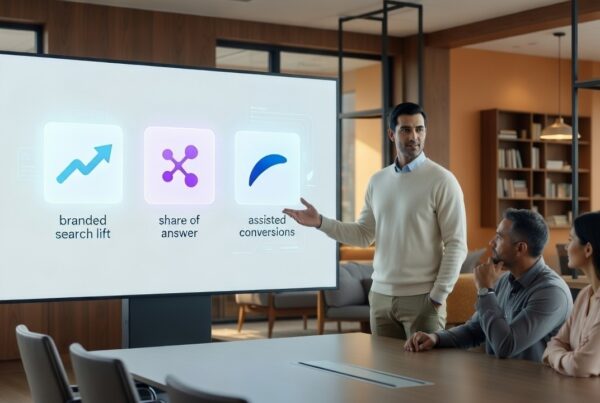
- Share of answer on the locked panel
- Accuracy grades
- Branded search movement
- AI referral quality (when clicks exist)
- Sales anecdotes coded to tools
Keep the scoreboard tied to the before-the-click visibility system so pre-click influence does not disappear just because referral sessions look small.
What Not to Do
- Do not rebuild the site three times for three engines
- Do not swap classic SEO for chat cosplay
- Do not publish “AI content” that adds adjectives but no extractable facts
- Do not celebrate a single Overview screenshot as a strategy
- Do not ignore wrong answers—silent errors train buyers
Search still needs a context-first playbook. Keywords matter. Context and consistency matter more when machines summarize you.
A 30-Day “Optimize First” Plan
Days 1-7: Pick the lane with evidence
- Pull top commercial queries and landing pages
- Interview sales for AI-tool name-drops
- Choose primary platform (usually AI Overviews) and secondary (usually ChatGPT)
- Lock the prompt panel
Days 8-18: Spine + primary platform
- Repair contradictions on money pages
- Add answer blocks (definitions, steps, FAQs, comparisons)
- Improve proof modules
- Technical pass for crawl/index and page quality
- Re-test Overview/Google-path prompts
Days 19-30: Second platform + citation QA
- Re-test the same prompts in ChatGPT and Perplexity
- Log misses and wrong facts
- Ship two corroboration tasks (review velocity, partner mention, expert article, or case study upgrade)
- Set monthly scoreboard owners
If you need a structured outside pass, Brandastic ties this into SEO, content marketing, and broader services—or start with a search + visibility audit.
The Bottom Line
AI Overviews vs. ChatGPT vs. Perplexity is not a religious war.
- AI Overviews SEO protects the Google-shaped demand you already understand.
- ChatGPT visibility protects shortlist formation in conversational research.
- Perplexity SEO protects sourced, citation-heavy research journeys.
A sane GEO strategy builds one honest public spine, then sequences AI search platforms by where your buyers actually decide—not by which tool is the loudest on LinkedIn this week.
Optimize first where demand already walks. Make the brand legible there. Then widen the same truth to every answer engine that borrows it.
Frequently Asked Questions
What is the difference between AI Overviews SEO and classic SEO?
Classic SEO targets rankings and clicks in search results. AI Overviews SEO still needs that foundation, but also optimizes for inclusion and accurate representation inside Google’s generated answer layer—where some users stop without clicking.
Should brands optimize for ChatGPT or Google first?
Most brands should keep Google (including AI Overviews) first if that is where demand starts, while running a parallel ChatGPT visibility loop on shortlist prompts. Only lead with ChatGPT if sales and research behavior already show chat-first discovery in your category.
What is Perplexity SEO?
Perplexity SEO means making your brand and pages easy to cite in Perplexity’s sourced answers: clear primary pages, consistent facts, strong proof, and third-party corroboration that a research-style engine can trust.
What does GEO strategy mean for multi-platform AI search?
A GEO strategy focuses on generative engine visibility—being understood, selected, and cited in AI answers across tools—using one consistent brand spine and platform-specific packaging and measurement.
Do AI search platforms use the same ranking factors?
No single shared ranking formula spans Google AI Overviews, ChatGPT, and Perplexity. They differ in retrieval, citation display, and product goals. Shared ingredients still matter: entity clarity, useful content, proof, consistency, and technical access.
How do citations differ across AI Overviews, ChatGPT, and Perplexity?
AI Overviews often pair summaries with Google-mediated links. ChatGPT’s citation behavior varies by product/mode and can be sparse. Perplexity commonly emphasizes visible sources as part of the research experience.
Can we rank on Google but still miss AI answers?
Yes. Google rankings do not guarantee AI citations. Answer systems can skip, mis-summarize, or prefer other sources even when you rank well for related queries.
How should we measure success beyond clicks?
Use a locked prompt panel to track presence, accuracy, and share of answer; watch branded search lift; track AI referral quality when clicks occur; and capture sales-reported AI influence. See how to measure AI search visibility before the click.
Is content volume the key to ChatGPT visibility?
No. Volume without clear offers, proof, and consistent entity facts rarely creates durable ChatGPT visibility. Specific, consistent, citable pages beat generic bulk publishing.
What should a brand fix first if budget is limited?
Pick one revenue offer. Make that page unmistakable on who it is for, what is included, proof, and next step. Align the homepage one-liner and key profiles to the same story. Re-test that offer’s prompts on your primary AI platform, then expand.