


Quick answer: Charter school SEO is the work of getting your school found when families search for schools in their city or “near me.” Google ranks local results on relevance, distance and prominence, so a charter school wins by having one accurate Google Business Profile per campus, a real page for every campus and grade span, steady parent reviews, links from the community, clear enrollment and lottery information, and plain answers that AI search tools can quote.
Key takeaways
- Google says local results are ranked mainly on three things: relevance, distance and prominence. You can improve relevance and prominence; distance you cannot change (Google).
- Each physical campus that welcomes families can have one Google Business Profile. Virtual offices are not eligible, which matters for online charters (Google).
- Build one useful page per campus, not dozens of thin city pages. Google treats near-identical city pages that funnel to one page as doorway abuse.
- Charter searches mix intent: “charter schools near me,” “tuition-free school [city]” and “[school name] lottery” each need a different page.
- NCES counts about 7,800 public charter schools serving 3.7 million students (2021-22 and fall 2021), so most families have more than one charter option to compare.
- Measure SEO by inquiries and applications from organic search and your Business Profile, not by rankings alone.
What is charter school SEO?
Charter school SEO is search engine optimization for a tuition-free public charter school: making your campus pages, Google Business Profile, reviews and content easy for Google and AI tools to understand, so your school appears when local families search for schools, grades or enrollment information in your city and nearby neighborhoods.
Most of the families you want are not searching for your school by name. They search for “charter schools near me,” “best elementary schools in [city],” “free public school options [city]” or “TK enrollment near me.” If you only rank for your own name, you are only reaching people who already know you.
The competition is real. According to the National Center for Education Statistics, the number of U.S. public charter schools grew from about 5,300 to 7,800 between 2010-11 and 2021-22, and charter enrollment more than doubled from 1.8 million to 3.7 million students between fall 2010 and fall 2021 (NCES). In the District of Columbia, 45% of public school students attended charters in fall 2021, and in Arizona the share was 20%. In markets like those, a family searching on a phone may see several charters, a district school and a private school on one screen.
If you want the general local playbook for every school type, read our guide to local SEO for schools. This post focuses on what is different for charters: lottery timing, tuition-free messaging, open enrollment across district lines and, for virtual charters, having no storefront at all.
How does Google decide which schools show up for “near me” searches?
Google ranks local results mainly on relevance, distance and prominence. Relevance is how well your profile matches the search, distance is how far your campus is from the searcher, and prominence is how well known you are, based partly on reviews, ratings and links. You can improve relevance and prominence, but not distance.
Google’s own help page spells this out. Relevance improves when your Business Profile has “complete and detailed business info.” Distance uses the searcher’s location, or what Google knows about it if they do not share it. Prominence draws on things like how many websites link to your business and how many reviews you have, and Google says more reviews and positive ratings can help local ranking (Google Business Profile Help).
For a charter school, that translates into three jobs:
- Relevance: pick accurate categories, list grade levels, describe your program in plain words, and make sure your website says the same things.
- Prominence: earn honest parent reviews, local news coverage, links from community partners and listings on your authorizer’s and state’s school directories.
- Distance: you cannot move the campus, but you can make sure every campus has its own accurate profile and page, so Google can match each one to the families around it.
Can a charter school have a Google Business Profile?
Yes. A charter campus that serves families in person at a real address can have one Google Business Profile per location. Use your real-world school name with no added keywords, choose the most specific category, list accurate hours, and verify the profile. A rented mailing address or virtual office is not eligible.
Google’s guidelines say your name should reflect your “real-world name, as used consistently on your storefront, website, stationery, and as known to customers,” and that you should not create more than one page for each location. Virtual offices are not eligible, and categories should not be used “solely as keywords” (Google Business Profile guidelines).
Common charter mistakes we see:
- Adding “Best Free Charter School in [City]” to the business name. It breaks the guidelines and can get the profile suspended.
- One profile for a network with five campuses. Each campus that receives families needs its own profile and its own page.
- A middle school and high school on the same site sharing one profile, then wondering why the middle school never appears. If they operate as distinct schools with separate entrances, offices or hours, check the guidelines for departments and separate listings.
- Hours that say “open 24 hours” because nobody set them. Use office hours and update them for breaks.
- Leaving the profile’s website link pointing at the network home page instead of the campus page.
Once the profile is live, use Business Profile posts for info sessions, lottery deadlines and tours, add real photos of classrooms and arrival, and answer questions. Our guide to schema markup for schools explains how to make your site and profile tell the same story.
How should a charter school structure its website for city searches?
Give every campus one strong page with its address, grades, schedule, transportation, enrollment steps, lottery dates and a map, then link those pages from a clear “Our schools” hub. Avoid making dozens of near-identical city pages; Google calls pages built to funnel each city’s searchers to one place doorway abuse.
Google’s spam policies list “having multiple domain names or pages targeted at specific regions or cities that funnel users to one page” as an example of doorway abuse (Google Search Central). That rules out the old trick of cloning a page for every suburb. What works instead is real content tied to real places:
| Page | What it should answer | Example search it can win |
|---|---|---|
| — | — | — |
| Campus page | Address, grades, bell times, transportation, meals, contact | charter school in [neighborhood] |
| Enroll or apply page | Who can apply, deadlines, lottery date, documents needed | [school name] application |
| Lottery and waitlist page | How the drawing works, preferences allowed by your charter, waitlist steps | [city] charter school lottery |
| Program pages | TK, dual language, STEM, independent study, special education services | dual language charter school [city] |
| Tuition-free explainer | Why a charter is public and free, who funds it, how it differs from private school | are charter schools free in [state] |
| Comparison or FAQ page | Charter vs district vs private, in plain words | charter vs public school [city] |
If you serve families from several cities, say so on the campus page with specifics: which cities your current families come from, bus or carpool options, and how far the drive is. That is useful information, not a doorway page.
What keywords should a charter school target?
Target four groups: discovery searches like “charter schools near me,” city and grade searches like “charter middle school [city],” program searches like “dual language school [city],” and decision searches like “[school name] lottery.” Map each group to one page, then check real search volume in your city before writing.
Search volume for school terms is small and very local, so do not trust national numbers. Use Google Search Console to see what families already type to find you, Google Business Profile performance to see searches that showed your profile, and a keyword tool set to your metro area. Then build a simple map:
- Discovery: charter schools near me, tuition-free schools [city], public school options [city].
- Grade and city: charter elementary [city], charter high school [county], TK [city].
- Program: STEM charter [city], dual language charter [city], independent study charter [state].
- Decision and brand: [school name] enrollment, [school name] lottery results, [school name] reviews.
The decision searches convert best and are the easiest to win, so make sure those pages exist and are current before you chase broad terms.
Why does “tuition-free” belong in your SEO?
Many families still assume a charter school charges tuition. Federal law defines a charter school as a public school that does not charge tuition and admits students by lottery when there are more applicants than seats (20 U.S.C. 7221i). Saying “tuition-free public charter school” in titles and on campus pages answers that doubt and matches how parents search.
Be accurate with it. If your school has fees for optional activities or uniforms, explain them. If your charter allows admission preferences, such as siblings or residents of the authorizing district, explain those in plain words on the lottery page. Clear information builds trust, and it prevents the frustrated phone calls that follow a misunderstanding.
How do reviews and community links help charter school rankings?
Reviews and links are the core of Google’s prominence signal. Ask current families for honest reviews after positive moments, reply to every review, and earn links from partners such as libraries, youth sports leagues, local news, chambers of commerce and your authorizer’s school finder. Never pay for, filter or script reviews.
Our guide to school reviews from parents covers how to ask without pressure. For charters, two moments work well: right after a family receives an offer and accepts, and after a successful first month. Ask in the family’s home language as well as English.
Links do not need to be fancy. A food bank thanking your student volunteers, a robotics league listing your team, or a city page listing schools in town are all real-world signals that your campus exists and matters to the community.
How does page speed and mobile design affect charter school SEO?
Most school searches happen on phones, and many families depend on them. Pew Research Center reports that 91% of U.S. adults own a smartphone and 16% are “smartphone-only” internet users with no home broadband (Pew Research Center). A slow, cluttered campus page loses those families before they reach the enroll button.
Google’s Core Web Vitals give clear targets: Largest Contentful Paint within 2.5 seconds, Interaction to Next Paint of 200 milliseconds or less, and Cumulative Layout Shift of 0.1 or less (web.dev). Compress hero images, remove sliders, put the enroll button high on the page, and make sure the application works on a phone in English and Spanish.
How does AI search change charter school SEO?
AI tools like Google’s AI Overviews and ChatGPT answer “what are the best charter schools near me” with a short list and a few sources. They favor pages that answer questions directly, state facts like grades, address and enrollment dates clearly, and match what other trusted sites say about you. Clean, consistent facts help both search and AI.
That means the same habits that help classic SEO: one question per heading, a direct answer in the first sentence or two, current dates, and consistent details across your website, Business Profile, state directory and review sites. Our post on AI search for schools goes deeper. Structured data can help too; Google’s documentation describes how LocalBusiness markup can describe details like opening hours and departments (Google Search Central).
How do online and virtual charter schools do local SEO?
A virtual charter usually cannot have a normal Business Profile unless it has a staffed location that receives families during business hours. Instead, it should rank with statewide and county pages that explain eligibility, devices, learning coaches and testing sites, plus a strong presence for “online public school [state]” searches.
Virtual charters compete on eligibility. A family in a rural county wants to know whether they can enroll, what the school day looks like and whether the school is truly free. County or region pages work when each one has real local facts, such as testing locations, field trip areas or local staff, not swapped city names. Our charter and online school marketing case study shows how search fits into a full enrollment campaign.
How long does charter school SEO take?
Google says some changes show up in a few hours and others take several months, and suggests waiting a few weeks before judging a change. For charters, plan SEO a full enrollment cycle ahead: pages and profiles fixed in late summer and fall, so they are ranking when lottery season starts.
Google’s SEO starter guide puts it plainly: “Some changes might take effect in a few hours, others could take several months” (Google Search Central). Schools with fixed application windows feel this more than most. A lottery page published two weeks before the deadline will not help much this year. Treat SEO as the base layer, and use paid search to cover gaps while organic pages mature. Our guide to Google Ads for schools explains how the two work together.
How should a charter school measure SEO?
Track three layers: visibility (Search Console impressions and Business Profile views by campus), actions (calls, direction requests, website clicks and inquiry form starts) and outcomes (applications, offers and enrollments from organic search). Report by campus and by enrollment stage, so the board sees seats, not just traffic.
Rankings bounce around by device and location, so treat them as a diagnostic, not the goal. Tag your Business Profile website link with UTM parameters so profile visits do not hide inside “organic,” and keep the source with each family in your CRM. Our guide to school marketing attribution shows how to connect search to enrolled students, and our school admissions CRM guide covers the system side.
What SEO mistakes do charter schools make most often?
- Ranking only for the school name and ignoring discovery searches.
- One generic “Enroll” page for every campus, with no campus-specific details.
- Lottery dates left over from last year, which confuses families and AI answers.
- PDF-only enrollment packets that cannot be read on a phone or by search engines.
- Spanish pages that are machine-translated and never reviewed.
- Keyword-stuffed Business Profile names that get suspended in the middle of lottery season.
- Cloned city pages that Google may treat as doorways.
- No one assigned to answer reviews and Business Profile questions.
Does this apply to colleges too?
The same principles help colleges and universities, though their searches are more about programs than distance. A community college campus page, a program page that answers cost and schedule questions, and consistent facts across directories all matter. Our guide to higher education SEO covers program-level search for colleges.
Channels Brandastic manages
Brandastic plans and runs these channels for colleges and schools:
Every engagement starts with a first-month discovery and strategy phase. A strong strategy is what makes the campaigns work, so before anything launches we:
- Study your market and the schools you compete with for families.
- Define your ideal target families.
- Identify the parents, students and influencers to market to and what they care about.
- Build a communication plan: what to say, on which channels, and when.
- Pin down your school’s pain points, such as low inquiries or weak follow-up, and plan how to solve them.
- Decide whether to market locally, nationally or both.
For an example of results at scale, Brandastic’s enrollment campaigns for California Online Public Schools produce 1,500+ leads a month and 118x ROAS.
About the author: Justin Nassie is the President and Founder of Brandastic, an Orange County digital marketing agency he has run for 16 years. He has taught advanced web at Chapman University and has also taught at UC Irvine (UCI).
Keep reading: What an education marketing agency does; Local SEO for schools; Charter school lottery marketing; Best charter school marketing agencies; Schema markup for schools.
Frequently asked questions
What is charter school SEO?
It is search engine optimization for a tuition-free public charter school, so its campus pages, Google Business Profile and content show up when local families search for schools, grades and enrollment information.
How do charter schools rank for “near me” searches?
Keep one accurate Google Business Profile per campus, build a strong page for each campus, earn honest parent reviews and community links, and keep enrollment details consistent everywhere.
Should we create a page for every city we serve?
Only if each page has real, unique local information. Near-identical city pages that funnel visitors to one place can be treated by Google as doorway abuse.
Can an online charter school have a Google Business Profile?
Only for a staffed location that receives families during stated hours. A rented mailing address or virtual office is not eligible.
Should we put “free” or “tuition-free” in our page titles?
Yes, if it is accurate. Charter schools are public and do not charge tuition under federal law, and many parents search for free school options.
How long does charter school SEO take?
Google says changes can take from a few hours to several months. Fix pages and profiles well before your application window opens.
Does Brandastic do SEO for charter schools?
Yes. Brandastic runs SEO, Google Business Profile, paid search and enrollment tracking for charter and public schools.
Our Work in Education
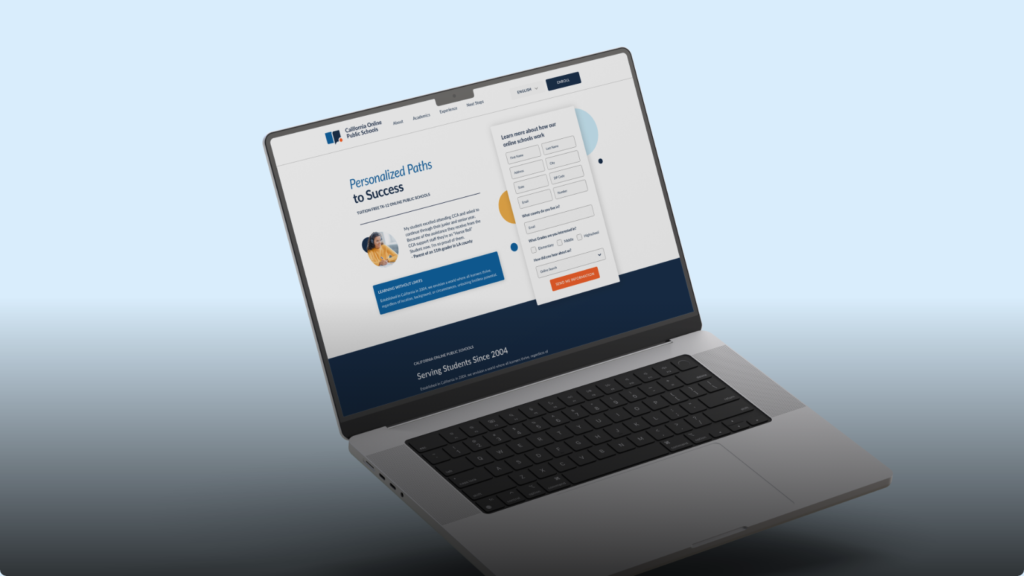
PORTFOLIO · ONLINE CHARTER SCHOOL
California Online Public Schools
1,500+ leads a month and 118x ROAS
View Project

Want families to find your charter school before the lottery deadline? Book your free consultation.
Sources
- NCES Fast Facts, Charter schools, https://nces.ed.gov/fastfacts/display.asp?id=30
- Google Business Profile Help, Tips to improve your local ranking on Google, https://support.google.com/business/answer/7091
- Google Business Profile Help, Guidelines for representing your business on Google, https://support.google.com/business/answer/3038177
- Google Search Central, Spam policies for Google web search (doorway abuse), https://developers.google.com/search/docs/essentials/spam-policies
- Google Search Central, SEO Starter Guide, https://developers.google.com/search/docs/fundamentals/seo-starter-guide
- Google Search Central, Local business structured data, https://developers.google.com/search/docs/appearance/structured-data/local-business
- Pew Research Center, Mobile fact sheet, https://www.pewresearch.org/internet/fact-sheet/mobile/
- web.dev, Web Vitals, https://web.dev/articles/vitals
- 20 U.S.C. 7221i, Definitions (charter school), https://www.law.cornell.edu/uscode/text/20/7221i
- Brandastic case study: California Online Public Schools
By Justin Nassie, President and Founder of Brandastic. Brandastic is a Costa Mesa, California digital marketing agency founded in 2010 that has worked with 450+ brands and is a Google and Microsoft Partner. Last updated November 12, 2026.


