


Quick answer: Digital marketing services for schools are the paid and organic online services that help families find, compare and apply to your school: strategy, website and landing pages, search engine optimization, paid search, paid social, email and text, content, reviews and measurement. Charter and public schools should buy the services that fix their biggest enrollment gap first, keep ownership of their accounts and data, and pay for outcomes they can measure, such as inquiries, applications and enrolled students, not clicks alone.
Key takeaways
- In Niche’s fall 2024 survey of 377 K-12 parents, school websites influenced 91% of families and presence on search and review sites influenced 89%. Those two services come first.
- Google was the top starting point for 50% of parents in that survey, and Niche for 25%.
- Pew reports 91% of U.S. adults own a smartphone and 16% are smartphone-only internet users. Every service you buy must work on a phone.
- NCES counted 48.9 million public school students in 2022-23, about 3.7 million of them in charter schools. Charters compete for attention in every one of those markets.
- Own your Google Ads, Meta, analytics and website accounts. Vendors should be users, not owners.
- Judge services by cost per application and per enrolled student, with caveats, not by impressions.
What are digital marketing services for schools?
Digital marketing services for schools are the online activities that bring families to your school and move them toward enrolling. They usually fall into eight groups: strategy and planning, website and landing pages, search engine optimization, paid search, paid social and video, email and text, content and creative, and measurement and reporting. A school can buy them one at a time, as a bundle from one agency, or split them between staff and outside partners.
This guide is for charter school leaders, district communications directors and enrollment teams deciding what to buy. It is not a channel how-to. It explains what each service is for, what good looks like and how to judge a proposal.
Why are charter and public schools buying digital marketing services now?
Families research online first. In Niche’s October 2024 pulse survey of 377 parents and guardians with a child entering kindergarten through 12th grade in fall 2025, Google (50%) and Niche (25%) were the most common starting points for a school search. School websites influenced 91% of respondents, presence on search and review sites 89%, emails from schools 82% and social media 61% (Niche).
Competition is real even for public schools. NCES counted 48,861,000 public school students in 2022-23, including 3,718,000 in charter schools (NCES). The National Alliance for Public Charter Schools reports nearly 4 million charter students in more than 8,100 schools and says 11 states have a charter market share of 10% or more (NAPCS). In those markets, district schools, charters, magnets and private schools all advertise to the same families.
Which digital marketing services do schools actually need?
Not every school needs every service. Use this table to match services to the problem you are solving:
| Service | What it does | Buy it when |
|---|---|---|
| Strategy and planning | Sets goals, audiences, messages, budget split and calendar | Always, first |
| Website and landing pages | Gives families a clear place to learn and act | Your site is slow, confusing or hard to use on phones |
| SEO and local SEO | Helps you appear for searches families make | Few families find you without ads |
| Paid search | Shows ads to families searching now | You have a deadline or open seats |
| Paid social and video | Builds awareness and retargets interested families | Few families know you exist |
| Email and text | Moves inquiries to tours and applications | Inquiries stall after the first contact |
| Content and creative | Produces pages, posts, photos and video | Your message is vague or your photos are stock |
| Measurement and reporting | Connects spend to applications and enrollment | You cannot answer what last year’s budget produced |
Strategy and planning
Strategy decides everything else, so buy it first. A good strategy names your target families, the one sentence you want them to remember, the channels you will use, the budget split and the numbers you will report. Our school marketing plan template shows the structure.
Website and landing pages
Your website is the service most families touch. It should load fast on phones, put enrollment steps and dates near the top and make the next action obvious. Pew reports that 91% of U.S. adults own a smartphone and 16% are smartphone-only internet users (Pew Research Center). For those families, a site that only works on a laptop does not work.
SEO and local SEO
Search engine optimization helps your school show up when families search for schools in their area. For public and charter schools, local SEO matters most: a complete Google Business Profile, consistent facts across listings and pages that answer local questions. Read our guide to local SEO for schools.
Paid search
Paid search shows your ad to families who are searching right now. It works best around deadlines and for open seats. It needs careful targeting to your enrollment area and negative keywords to avoid wasted clicks. See Google Ads for schools for the setup basics.
Paid social and video
Meta, YouTube and other platforms reach families who are not searching yet. Use them to introduce your school, promote events and remind families who started an application. Our post on Facebook and Instagram ads for schools covers creative and targeting.
Email and text
These are the services schools most often underbuy. A family that inquires and hears nothing for a week is likely gone. Automated welcome emails, event reminders and deadline texts, with consent, keep families moving. See our guide to school inquiry response time.
Measurement and reporting
Measurement turns spending into evidence. Ask for tracking that records the source of every inquiry and sends applications back to ad platforms as conversions. Google Ads supports importing conversions that happen offline, such as an application recorded in your enrollment system (Google Ads Help), and enhanced conversions that improve measurement with hashed first-party data (Google Ads Help). Follow FERPA and your district’s privacy rules before sending any data from education records.
What should a school keep in-house?
Some work is better done by people who are at your school every day:
- Stories and photos. Staff see the moments families want to see. Give them a simple way to capture and share them, with consent.
- Answering families. Calls, emails and tours should be handled by your team, with clear response-time standards.
- Facts and approvals. Dates, eligibility rules and results should be owned and approved internally.
- Community relationships. Partnerships with churches, libraries, preschools and community groups belong to your leaders.
Outsource what needs specialist skill or volume: ad buying and optimization, technical SEO, tracking setup, design and video production at scale.
How should a school scope and compare proposals?
Ask every vendor to answer the same questions in writing, then compare like for like:
- What enrollment problem will you solve first, and how will we know?
- Which services are included, which are extra, and who does the work?
- Who owns the ad accounts, analytics, website and creative? (The answer should be: the school.)
- How will you track inquiries, applications and enrolled students, not only clicks?
- What do you need from our staff each week?
- How do you handle public school rules on advertising, accuracy and public funds?
- Can you show results for charter or public schools, with permission to share?
- What happens to our accounts and data if we part ways?
Red flags include a vendor that wants to own your ad accounts, reports only impressions and clicks, promises guaranteed enrollment numbers, or cannot explain how they would reach every eligible family, including those who speak languages other than English.
How much should a school spend on digital marketing services?
Budgets vary widely by market, enrollment goal and how many seats you need to fill, so we do not publish a single figure. Start from the goal instead: how many applications do you need, what share are you likely to enroll and what has each enrolled student cost in past years? Our guide to planning a school marketing budget walks through the math. Public schools should also confirm how state law and their charter or board policy limit spending on advertising.
How do you know your digital marketing services are working?
Report monthly on a short list: inquiries, tour and info session sign-ups, applications started and completed, and enrollment, each by source. Add cost per application and cost per enrolled student once you have a full cycle of data, with honest caveats. Review it with leadership each quarter, and keep the services that move those numbers.
Channels Brandastic manages
Brandastic plans and runs these channels for colleges and schools:
Every engagement starts with a first-month discovery and strategy phase. A strong strategy is what makes the campaigns work, so before anything launches we:
- Study your market and the schools you compete with for families.
- Define your ideal target families.
- Identify the parents, students and influencers to market to and what they care about.
- Build a communication plan: what to say, on which channels, and when.
- Pin down your school’s pain points, such as low inquiries or weak follow-up, and plan how to solve them.
- Decide whether to market locally, nationally or both.
For an example of results at scale, Brandastic’s enrollment campaigns for California Online Public Schools produce 1,500+ leads a month and 118x ROAS.
About the author: Justin Nassie is the President and Founder of Brandastic, an Orange County digital marketing agency he has run for 16 years. He has taught advanced web at Chapman University and has also taught at UC Irvine (UCI).
Keep reading: What an education marketing agency does; School marketing plan template; Planning a school marketing budget; Google Ads for schools; Local SEO for schools.
Frequently asked questions
What digital marketing services do schools need?
Most need strategy, a phone-friendly website, local SEO, paid search around deadlines, paid social for awareness, email and text follow-up, and measurement that connects spend to applications.
Which service should a charter school buy first?
Strategy first, then fix the website and enrollment page. In Niche’s 2024 survey, school websites influenced 91% of K-12 parents.
Should a school outsource digital marketing?
Outsource specialist work such as ad buying, technical SEO, tracking and production. Keep stories, family communication, facts and community relationships in-house.
Who should own a school’s ad accounts?
The school. Vendors should have user access to Google Ads, Meta, analytics and the website, but the school should own the accounts, data and creative.
How do I compare digital marketing proposals for schools?
Ask every vendor the same written questions about the problem they will solve, services included, account ownership, tracking, staff time, public school rules and past results.
How much do digital marketing services for schools cost?
It depends on your market, goals and seats to fill. Start from the number of applications you need and your past cost per enrolled student instead of a fixed figure.
How do you measure school digital marketing?
Track inquiries, tours, applications and enrollments by source each month, then add cost per application and per enrolled student after a full enrollment cycle.
Does Brandastic offer digital marketing services for schools?
Yes. Brandastic provides strategy, paid search, paid social, SEO, content and measurement for charter and public schools, and offers a free consultation.
Our Work in Education
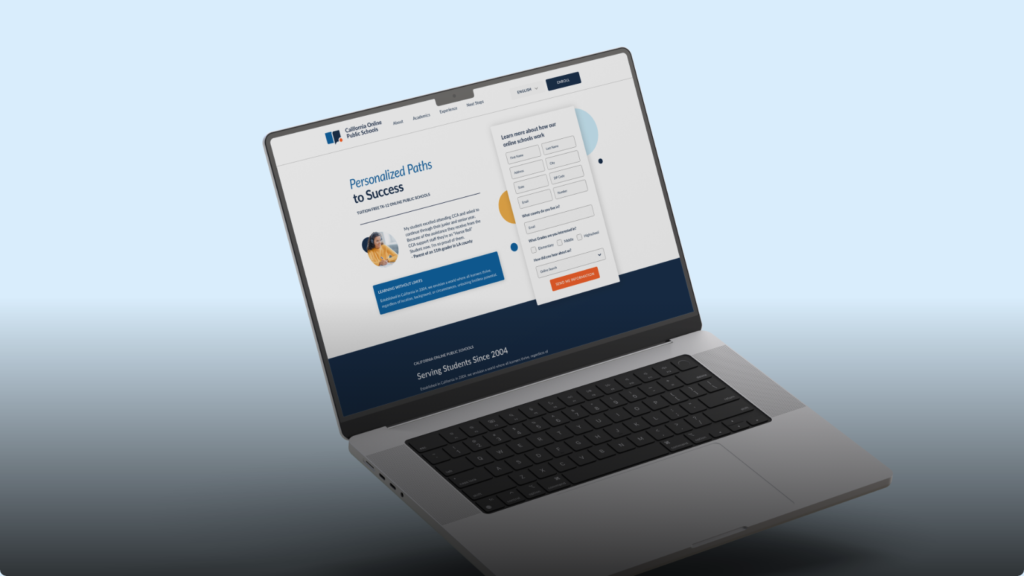
PORTFOLIO · ONLINE CHARTER SCHOOL
California Online Public Schools
1,500+ leads a month and 118x ROAS
View Project

Want help choosing the right digital marketing services for your school? Book your free consultation.
Sources
- Niche, Your mid-cycle pulse check: Real-time insights on K-12 parent search (Oct. 31, 2024; 377 parent and guardian responses), https://www.niche.com/about/enrollment-insights/2024-niche-k-12-parent-survey/
- NCES, Digest of Education Statistics 2023, Table 216.30, traditional and charter public school students and schools, https://nces.ed.gov/programs/digest/d23/tables/dt23_216.30.asp
- National Alliance for Public Charter Schools, Enrollment Brief: Charter Schools 2025 (Nov. 2025), https://publiccharters.org/wp-content/uploads/2025/11/NAPCS-2025_Enrollment-Brief-111425v1.pdf
- Pew Research Center, Americans’ Use of Mobile Devices in 2026 (Oct. 19, 2026), https://www.pewresearch.org/internet/fact-sheet/mobile/
- Google Ads Help, About offline conversion imports, https://support.google.com/google-ads/answer/2998031
- Google Ads Help, About enhanced conversions, https://support.google.com/google-ads/answer/9888145
- U.S. Department of Education, Student Privacy Policy Office, FERPA, https://studentprivacy.ed.gov/ferpa
- Brandastic case study: California Online Public Schools
By Justin Nassie, President and Founder of Brandastic. Brandastic is a Costa Mesa, California digital marketing agency founded in 2010 that has worked with 450+ brands and is a Google and Microsoft Partner. Last updated October 28, 2026.


