


Quick answer: School choice marketing for charter schools means helping families understand they have options and that your school is one of them: public, tuition-free and open to all. Lead with the plain facts parents get wrong, show what makes your program different, and give a clear next step. Keep enrollment ads about your school, not about policy debates, because advocacy ads trigger extra rules on Meta and Google and can raise public-funds questions.
Key takeaways
- Federal law defines a charter school as a public school that does not charge tuition, is nonsectarian and uses a lottery when more students apply than it has seats (20 U.S.C. 7221i).
- Public charter school enrollment more than doubled from 1.8 million to 3.7 million students between fall 2010 and fall 2021, and charters grew from 5% to 8% of all public schools (NCES).
- Do not assume families know charter schools are free. Put “tuition-free public school” in your headline, not your fine print.
- Meta treats education as one of its U.S. social issue categories. Ads that argue for or against education policy need authorization and a “Paid for by” disclaimer.
- Google treats ads about qualified state ballot measures as U.S. Election Ads, which require advertiser verification.
- Compare programs, not people. Ads that run down neighboring district schools damage trust and invite complaints.
What is school choice marketing?
School choice marketing is the work of telling families they can choose a public school other than the one assigned by their address, and showing why a specific school fits their child. For a charter school, it starts with the basics: you are public, you are tuition-free, anyone in your area can apply, and here is how.
The audience is not only parents who already know the charter landscape. Many of the families who would benefit most have never compared schools at all. They need a short, clear explanation before they need a sales message.
The market is large enough to matter. According to the National Center for Education Statistics, public charter school enrollment more than doubled between fall 2010 and fall 2021, from 1.8 million to 3.7 million students, and the number of charter schools grew from about 5,300 to 7,800 (NCES). In Colorado, Nevada, Florida, Louisiana, Delaware, California, Utah and Michigan, 10 to 15 percent of public school students attended charters in fall 2021 (NCES).
Why does tuition-free messaging matter so much?
Tuition-free messaging matters because cost is the first filter many families apply, and parents who are new to charter schools may assume one charges tuition like a private school. If a parent believes your school costs money, they will never read about your teachers, your outcomes or your lottery dates.
The facts are on your side. Under federal law, a charter school is a public school that does not charge tuition, is nonsectarian in its programs and admissions, and admits students by lottery if more students apply than it can accommodate (20 U.S.C. 7221i). Say that plainly and early.
Where tuition-free should appear:
- Ad headlines. “Tuition-free public charter school” belongs in the first line, not the description.
- Website hero. The first sentence a visitor sees should name your grades, your city and “free public school.”
- Google Business Profile. Your description and Q&A should answer “Is it free?” directly.
- Flyers and signs. One line, large type: “Free. Public. Open to all.”
- Every language you serve. “Escuela pública chárter gratuita” carries the same weight in Spanish ads.
Be precise. Some schools charge for optional items such as before- and after-school care, field trips or uniforms. Do not hide those. Say “tuition-free” rather than “completely free,” and list any optional fees on your FAQ page.
What do families need to understand about school choice?
Families need four answers before they will act: what kinds of public schools they can choose, whether they qualify, what it costs, and when and how to apply. Most confusion comes from the words themselves, so define terms in plain language.
| Term | Plain-language definition |
|---|---|
| — | — |
| Charter school | A public school run under a charter with more freedom over its program. Tuition-free, open to all, lottery if oversubscribed. |
| Magnet school | A public school with a theme, such as STEM or the arts, usually run by the district. |
| Open enrollment | A policy that lets students attend a public school other than their assigned one, if there is space. |
| Neighborhood school | The public school assigned to your address. |
| Private school | A school that charges tuition and is not run by the public system. |
A simple comparison page like this, written for parents and kept up to date, also helps search engines and AI assistants explain your school correctly. Our guide to AI search for schools explains why clear definitions get quoted.
Parent questions to answer on your site, in this order:
- Is it really free?
- Who can apply, and do we have to live in a certain district?
- How does the lottery work, and are there sibling or other priorities?
- Is there transportation and lunch?
- What support is there for students with disabilities and English learners?
- What are the dates?
How should a charter school position itself against other options?
Position your school on what is distinctive about your program, not on what is wrong with other schools. Parents respond to specifics: a curriculum model, class structure, a language program, a college or career focus, or a school culture they can see in photos and video.
Positioning that works:
- Name the fit. “For families who want a bilingual K-8” or “For students who learn best through projects” tells parents quickly whether to keep reading.
- Show proof. Use real, dated, sourced results from your state report card, and say what year they cover.
- Show people. Teachers, families and students in their own words. Our post on school reviews from parents covers how to collect and use them.
- Answer the comparison honestly. If you do not offer busing or a sports program, say what you do instead.
Avoid comparative claims about named district schools. Ads that say a neighboring school is failing or unsafe tend to backfire with the families you want, damage relationships you may need later, and can draw complaints to your authorizer. Compare models and options, not reputations.
Where is the line between enrollment marketing and advocacy?
Enrollment marketing promotes your school and its application. Advocacy argues for or against a law, policy, ballot measure or official. Keep your enrollment campaigns on the first side, because advocacy ads carry extra platform rules and may raise questions about using public funds.
What the platforms say:
- Meta. Meta lists education as one of its 10 U.S. social issue categories (Meta). Ads that discuss, debate or advocate on a social issue need authorization and a “Paid for by” disclaimer, while ads whose main purpose is promoting a service may not (Meta Business Help Center).
- Google. Google defines U.S. Election Ads to include ads about a state ballot measure, initiative or proposition that has qualified for the ballot, and those ads may run only from verified advertisers (Google Ads Policies).
In practice:
| Enrollment ad (usually fine) | Advocacy ad (extra rules) |
|---|---|
| — | — |
| “Tuition-free K-8. Apply by March 1.” | “Tell lawmakers to fund school choice.” |
| “Open house Saturday. Meet our teachers.” | “Vote yes on the school choice measure.” |
| “Bilingual program now enrolling grades K-2.” | “Our state needs more charter schools.” |
Public charter schools also spend public money, and many states limit using public funds for political campaigns. If your board or network wants to run advocacy, check with counsel first and keep it separate from enrollment budgets, accounts and landing pages.
Which channels work best for school choice messaging?
The best channels reach families who are not yet comparing schools as well as those who are. Search captures parents already looking, while local social, video, community events and word of mouth introduce the idea of choice to families who have not considered it.
| Channel | Role in school choice marketing |
|---|---|
| — | — |
| Google Search | Captures “charter schools near me,” “free schools in [city]” and branded searches. See Google Ads for schools. |
| Google Business Profile | Local results depend mainly on relevance, distance and popularity (Google). A complete profile helps parents find you. See local SEO for schools. |
| Meta (Facebook and Instagram) | Short video and carousel ads explaining “free, public, open to all” to parents in your area. |
| YouTube and Demand Gen | Teacher and family video for awareness. See Demand Gen ads for schools. |
| Community events | Libraries, churches, community centers and early learning programs. |
| Text and email | Follow-up for families who inquire. |
Events still matter. In Niche’s October 2024 survey of K-12 parents, 38% said attending an enrollment event was their first step with a school (Niche).
How do you reach families who do not know they have a choice?
Reach them where they already are, in their language, with a message that explains choice before it sells a school. These families are often missed by search ads because they are not searching yet, so community partners, neighborhood awareness ads and in-person help do most of the work.
Tactics:
- Partner with trusted messengers. Preschools, pediatric clinics, family resource centers and faith communities can share a flyer or host a short info session.
- Run awareness ads by neighborhood. Target the ZIP codes in your enrollment area evenly, not only the ones with the cheapest clicks.
- Translate fully. Ads, landing pages, forms and phone follow-up in every language your community speaks.
- Explain the process in one image. “1. Apply online. 2. Lottery on March 15. 3. Get your offer.” A simple visual beats paragraphs.
- Offer help applying. Office hours, a phone line and in-person help for families without reliable internet.
Equity is part of the mission. A charter school that is open to all should be able to show that it marketed to all.
How do you measure school choice marketing?
Measure applications by source, neighborhood and language, not just clicks or impressions. The real question is whether your messaging reached families across your whole enrollment area, in every language you serve, and turned into completed applications, accepted offers and enrolled students.
Track:
- Applications and completed applications by channel, ZIP code and language.
- The share of applicants new to charter schools, if you ask on the form.
- “How did you hear about us?” answers, to capture events and word of mouth.
- Offer acceptance and fall enrollment, so you know which channels bring families who stay.
For the method, see school marketing attribution and how to track which ads lead to enrolled students.
Does this apply to colleges?
Higher education faces a related challenge: explaining cost and aid clearly to families who assume college is out of reach. The same principles carry over to charter schools. Lead with the fact families get wrong, define terms plainly, and keep promotional messaging separate from policy advocacy.
What mistakes should charter schools avoid?
- Burying “tuition-free” in small print or leaving it off ads.
- Saying “completely free” when optional programs carry fees.
- Attacking named district schools in ads.
- Mixing enrollment ads with policy or ballot advocacy, especially in the same ad account.
- Running English-only campaigns in multilingual neighborhoods.
- Targeting only the cheapest ZIP codes, which skews who applies.
- Using enrollment or outcome numbers without a source and a year.
For the full lottery season playbook, see charter school lottery marketing.
Channels Brandastic manages
Brandastic plans and runs these channels for colleges and schools:
Every engagement starts with a first-month discovery and strategy phase. A strong strategy is what makes the campaigns work, so before anything launches we:
- Study your market and the schools you compete with for families.
- Define your ideal target families.
- Identify the parents, students and influencers to market to and what they care about.
- Build a communication plan: what to say, on which channels, and when.
- Pin down your school’s pain points, such as low inquiries or weak follow-up, and plan how to solve them.
- Decide whether to market locally, nationally or both.
For an example of results at scale, Brandastic’s enrollment campaigns for California Online Public Schools produce 1,500+ leads a month and 118x ROAS.
About the author: Justin Nassie is the President and Founder of Brandastic, an Orange County digital marketing agency he has run for 16 years. He has taught advanced web at Chapman University and has also taught at UC Irvine (UCI).
Keep reading: What an education marketing agency does; Charter school lottery marketing; Best charter school marketing agencies; School branding; What is enrollment marketing?; Charter and online school marketing case study.
Frequently asked questions
What is school choice marketing?
It is marketing that tells families they can choose a public school other than their assigned one, and shows why a specific school, such as a charter, fits their child.
Are charter schools tuition-free?
Yes. Federal law defines a charter school as a public school that does not charge tuition. Some schools charge for optional programs, so list those on your FAQ page.
Should charter schools say “free” in ads?
Yes. Put “tuition-free public school” in the headline. Use “tuition-free” rather than “completely free” if optional services carry fees.
Can a charter school run ads supporting school choice policy?
Policy and ballot advocacy ads face extra rules: Meta requires authorization for education issue ads and Google requires verification for ballot measure ads. Check public-funds rules with counsel.
Is it okay to compare a charter school to district schools?
Compare programs and options, not reputations. Avoid claims that named schools are failing, which tends to backfire and can draw complaints.
How do charter schools reach families who are not searching?
Use trusted community partners, neighborhood awareness ads, events, full translation and in-person application help.
What should a charter school website say first?
Your grades, your city, that you are a free public school open to all, and the next application date.
Does Brandastic help charter schools with school choice marketing?
Yes. Brandastic plans and runs enrollment campaigns for charter and public schools across search, social, video and text.
Our Work in Education
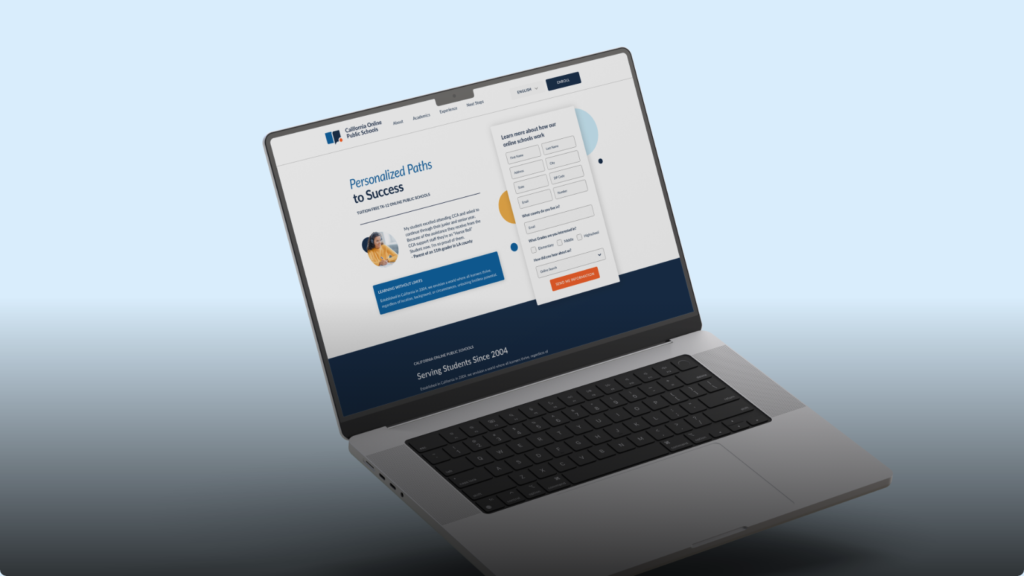
PORTFOLIO · ONLINE CHARTER SCHOOL
California Online Public Schools
1,500+ leads a month and 118x ROAS
View Project

Want more families to know your school is a free public option? Book your free consultation.
Sources
- 20 U.S.C. 7221i, Definitions (charter school), https://www.law.cornell.edu/uscode/text/20/7221i
- National Center for Education Statistics, Public Charter School Enrollment (Condition of Education, last updated May 2023), https://nces.ed.gov/programs/coe/indicator/cgb
- Meta, Updates to ads about social issues, elections or politics in the US (Aug. 28, 2019), https://about.fb.com/news/2019/08/updates-to-ads-about-social-issues-elections-or-politics-in-the-us/
- Meta Business Help Center, About ads about social issues, elections or politics, https://www.facebook.com/business/help/214754279118974
- Google Ads Policies, Political content, https://support.google.com/adspolicy/answer/6014595
- Google Business Profile Help, Tips to improve your local ranking on Google, https://support.google.com/business/answer/7091
- Niche, Your mid-cycle pulse check: Real-time insights on K-12 parent search (Oct. 31, 2024), https://www.niche.com/about/enrollment-insights/2024-niche-k-12-parent-survey/
- Brandastic case study: California Online Public Schools
By Justin Nassie, President and Founder of Brandastic. Brandastic is a Costa Mesa, California digital marketing agency founded in 2010 that has worked with 450+ brands and is a Google and Microsoft Partner. Last updated November 6, 2026.


