Most content libraries are built from the same public ingredients: recycled tips, third-party stats, and generic “best practices.” That work can fill a calendar. It rarely becomes a content moat.
AI answer engines already have access to commodity information. What they still need—and what competitors can’t copy overnight—is first-party research: original data, proprietary insights, and proof only your organization can produce.
If you want AI citations, stop asking “What should we write?” and start asking “What can we measure, anonymize, and publish that nobody else has?”
That shift is a core move inside answer engine optimization (AEO) and modern SEO: become a source of facts, not a mirror of the SERP.
What Counts as First-Party Research?
First-party research is evidence generated from your audiences, operations, customers, or experiments—not borrowed from someone else’s report.
High-value formats include:
| Type | Examples | Why AI tools like it |
| Surveys | Customer, prospect, or industry polls | New primary data |
| Benchmark reports | Channel media conversion ranges, CAC/ROAS bands | Decision-ready numbers |
| Internal performance trends | Anonymized multi-account patterns | Hard-to-fake operator insight |
| Customer insights | Structured interviews, win/loss themes | Language + jobs-to-be-done |
| Experiments | Tests with method + result | Causal findings |
| Proprietary frameworks | Scoring models, maturity grids, index methods | Named, reusable structure |
| Lifecycle outcome studies | Lead quality, revenue impact, retention effects | Business-result citations |
Original data marketing is the discipline of turning those assets into public, citable content—not leaving them buried in decks and dashboards.
Why First-Party Research Earns AI Citations
Answer engines prefer sources that reduce uncertainty. Public consensus is easy to paraphrase. Proprietary numbers are easier to attribute.
First-party research helps because it is:
- Scarce— not already on 200 blogs
- Specific—includes sample, method, timeframe, segment
- Attributable—clearly tied to a named organization
- Useful—helps someone choose, budget, or benchmark
- Refreshable— annual or quarterly updates creates a living source
This is how soft expertise becomes measurable operating proof: revenue impact, lead quality, ROAS, CAC, conversion gains, and lifecycle outcomes—the same proof standard behind strong case work like our SEO/AEO case study, LabTech results, and KIA organic growth study.
The Content Moat Test
Before you invest, run the moat test:
If a smart competitor with a good writer tried to recreate this next month, could they?
- No moat: “10 SEO tips for 2026”
- Weak moat: “Opinions from our team” with no data
- Real moat: “Across 40 anonymized B2B accounts, median CAC fell X% after Y change—method included”
Proprietary insights only become a moat when they’re documented, consistent, and public enough to cite.
A Practical System to Build Research AI Will Reference
1. Start From Questions the Market Already Asks
Research fails when it answers questions nobody is asking.
Mine:
- Sales call objections
- Support tickets
- “What does good look like?” procurement questions
- Keyword and AI-answer gaps
- Benchmark requests prospects already email you
Turn each into a research question:
- What is a realistic conversion range for ___?
- How long until ___ moves CAC / ROAS / pipeline quality?
- Which lead sources produce higher lifecycle value?
- What separates top-quartile operators from the median?
Your research roadmap should map to demand—then exceed it with proof.
2. Pick a Method You Can Defend
AI tools and skeptical humans both punish fuzzy methods.
| Method | Best for | Minimum to publish |
| Survey | Attitudes, budgets, behaviors | Who, when, questions, bias notes |
| Benchmark panel | Performance ranges | Segment definitions, sample size, time window |
| Anonymized portfolio trend | Operator reality | Inclusion rules, metrics definitions, caveats |
| Experiment / test | Causal claims | Hypothesis, setup, result, limits |
| Win/loss interviews | Qualitative insight | Count, roles, coded themes |
| Framework + scored sample | Maturity / index | Scoring rules, sample, distribution |
Rule: If you can’t explain how the number was born in five sentences, don’t publish the number.
3. Define Metrics Like an Operator, Not a Marketer
Vague labels kill citability.
Define:
- Lead quality—MQL vs. SQL vs. opportunity rate, or sales-accepted definition
- ROAS—revenue definition, attribution window, platform vs. blended
- CAC—what’s included (media only vs. fully loaded)
- Conversion rate—which step to which step
- Lifecycle outcomes—time-to-value, retention, expansion, payback
Clear definitions make proprietary insights reusable in AI answers without distortion.
4. Anonymize Without Watering Down
You can protect clients and still be specific.
Do:
- Aggregate by industry, size, model, or channel
- Use ranges and percentiles (p25 / median / p75)
- Share relative lifts (“+28% SQL rate”) with context
- Strip names unless you have approval (then make it a case study)
Don’t:
- Publish one-off outliers as “the benchmark”
- Hide that a sample is tiny
- Imply causality from correlation
Ethics and clarity are part of long-term authority.
5. Package Findings for Extraction (AEO Packaging)
Great data locked in a 40-page PDF that few people or systems can parse will still underperform.
Publish an AI-readable research hub:
- Direct answer / key finding near the top
- Method summary early
- Bulleted findings
- Tables for benchmarks
- Charts with plain-language captions
- Quotable one-liners under each major result
- FAQ for “who was studied / how / limitations”
- Date stamped and versioned
This is structured content for citations—the same citability craft covered in strong AEO practice (AEO guide, LLM seeding).
6. Convert Soft Strengths Into Business Results
Advanced thought leadership doesn’t stop at vanity metrics.
Wherever possible, connect research to:
- Revenue impact
- Lead quality (not just lead volume)
- ROAS / efficiency
- CAC and payback
- Conversion gains by funnel stage
- Lifecycle outcomes (retention, LTV, expansion)
Example framing:
Weak: “Content engagement improved.”
Strong: “Accounts that shipped monthly first-party benchmarks saw a median 19% lift in sales-accepted leads over 90 days (B2B services, blended organic + email).”
That’s original data marketing executives can cite—and AI can reuse carefully.
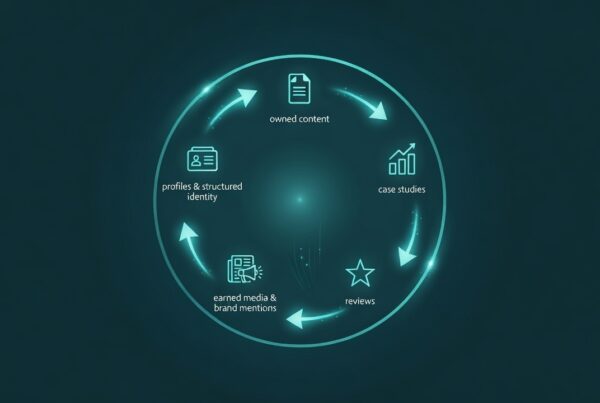
7. Build the Distribution Loop (Research → Citations → Demand)
Research is not “publish and pray.”
- Hub page on your domain (canonical source)
- Derivative assets— charts, LinkedIn findings, email series, sales one-pagers
- Earned media—offer embargoed charts to relevant publishers
- Sales enablement—same stats in decks and proposals
- Refresh cadence—quarterly pulse or annual index
- Internal links from service pages and related guides
Off-domain mentions of your data compound entity trust—a key part of turning AI visibility into leads.
8. Maintain the Asset Like Infrastructure
A one-time survey decays.
Treat flagship like a product:
- Owner
- Next field date
- Metric dictionary
- Known limitations log
- Changelog on the page
Fresh, versioned research beats a brilliant but abandoned 2022 PDF.
Research Designs Brandastic-Style Teams Can Run Without a Huge Lab
You don’t need a university budget. You need discipline.
A) Anonymized Performance Benchmark
- Pull 12-36 months of structured metrics across accounts
- Segment by industry / offer / traffic model
- Publish median and quartile ranges
- State inclusion and caveats
B) Prospect + Customer Survey
- 15 questions max
- Mix firmographics + behavior + outcomes
- Incentivize carefully; disclose incentive
- Report base sizes per question
C) Win/Loss Insight Study
- 10-20 interviews
- Code themes (price, proof, timing, trust, competitor gap)
- Publish theme frequencies + representative quotes (permissioned)
D) Controlled Content / UX / Channel Tests
- Document hypothesis and setup
- Share lift + confidence limits honestly
- Turn into a methods-backed brief
E) Proprietary Index or Score
- Define pillars (i.e. content citability score: answer, clarity, proof, structure, entity consistency, freshness)
- Score a sample of pages or companies
- Publish distribution + top patterns
Named indexes are highly citable when the method is public.
What AI Tools Tend to Skip (Even If it Looks “Researchy”)
- Stats with no sample size or date
- “In our experience” with zero structure
- Charts without downloadable or HTML-readable takeaways
- Paywalled-only findings with no public abstract
- Marketing fluff surrounding one weak data point
- Inconsistent definitions across posts
- Unrelated keyword stuffing around study
If the finding can’t stand as a clean sentence with context, it’s unlikely to become a preferred reference.
90-Day Plan to Launch a Research Moat
Days 1-30: Instrument and Decide
- Pick 1 flagship question tied to revenue or pipeline quality
- Write the metric definitions
- Choose method + minimum sample
- Set anonymization rules
- Draft the page outline (findings → method → tables → FAQ)
Days 31-60: Collect and Analyze
- Field survey / pull portfolio data / run interviews
- QA outliers and segment sizes
- Produce 5-7 quotable findings
- Build 3-5 tables or figures with captions
Days 61-90: Publish and Seed
- Ship the canonical research hub
- Add links from SEO/service pages
- Create 5 derivative posts/snippets from the data
- Pitch 3 relevant publishers or partners with unique charts
- Train sales on the 3 strongest proof lines
- Schedule the next refresh
Pair the program with a longer roadmap like future-proof SEO strategies for 2027 so research compounds instead of becoming a one-off campaign.
How This Connects to Cases and Service Proof
Research and case studies reinforce each other:
- Research = pattern-level truth across a sample
- Case studies = deep proof for one narrative (KIA portfolio, LabTech)
Together they tell AI systems and buyers: this brand doesn’t only claim expertise—it measures it.
For the wider visibility stack (AEO / GEO / LLMO), see AEO vs. GEO vs. LLMO.
Bottom Line
First-party research is one of the strongest ways to earn AI citations because it creates facts the open web doesn’t already contain.
To make research AI tools actually want to reference:
- Ask market-real questions
- Use defensible methods
- Define metrics precisely
- Anonymize without vague-ifying
- Package for extraction (structure, tables, FAQs, dates)
- Tie findings to revenue, lead quality, ROAS, CAC, conversion, and lifecycle outcomes
- Distribute and refresh like a product
That’s original data marketing with a real content moat—and it’s how Brandastic thinks about proof-led growth, not content volume for its own sake.
Want help turning your operational data into citable first-party research? Brandastic builds SEO and AEO systems around proof, structure, and proprietary insight. Explore our services or get to know us.
Frequently Asked Questions
What is first-party research in marketing?
First-party research is original evidence you generate from your customers, prospects, operations, tests, or anonymized performance data—surveys, benchmarks, interviews, experiments, and proprietary models—rather than quoting someone else’s report.
Why does first-party research help with AI citations?
AI tools favor sources that add new, specific, attributable information. Original benchmarks and methods-backed findings are easier to trust and cite than generic advice repeated across the SERP.
What is original data marketing?
Original data marketing means collecting, packaging, and promoting your own data as public content assets—research hubs, charts, indexes, and briefs—so prospects, publishers, and answer engines reference your numbers.
How big does a sample need to be?
Bigger is better, but honesty beats fake precision. Publish the number, segment sizes, and limitations. A transparent study with n=40 and clear caveats can outperform a vauge “industry report” with no method.
Can small teams build a content moat with research?
Yes. Start with one narrow benchmark or win/loss study you can repeat. Consistency and clarity create the moat more than a giant one-time survey.
Should research be gated?
You can get the full PDF, but keep a public HTML abstract with key findings, method, and tables. Fully locked research is harder for AI tools and many humans to cite.
How is this different from a case study?
A case study proves one story in depth. First-party research shows patterns across a sample. You want both: cases for narrative proof, research for benchmarkable proprietary insights.
How often should we update flagship research?
At least annually for major indexes; quarterly for fast-moving channels (ads, AI search, conversion benchmarks). Always show the field dates on the page.