If it feels like your website traffic isn’t growing like it used to, even though you’re still checking all the SEO boxes, you’re not imagining things. Search itself is evolving. And with it, so is how your content gets discovered (or doesn’t).
The rise of generative AI search tools like Google’s Search Generative Experience (SGE), ChatGPT, Perplexity, and Bing Copilot is reshaping how users find information. These platforms don’t just show users a list of links. They generate answers, pulling information directly from online sources, sometimes without ever sending traffic to your site.
So, where does your brand fit in?
Welcome to Generative Engine Optimization (GEO), the next phase of search strategy. Here’s how to make sure your content doesn’t just exist online, but actively surfaces in the age of AI search.
Understanding the AI Shift in Search
Traditionally, Search Engine Optimization (SEO) has been about creating content that ranks well on search engine results pages (SERPs). You target the right keywords, optimize your site speed, build backlinks, and wait for organic traffic to roll in.
But generative engines aren’t playing by those rules anymore.
Instead of offering 10 blue links, they think. They read a user’s query, pull relevant context from the web, and craft a concise answer. This means your content may be helping someone find what they’re looking for, but they might never actually click through to your site.
In fact, according to Bain & Company, around 60% of all searches now end without a click, a trend driven largely by AI summaries. Additionally, roughly 80% of consumers say they use AI-generated answers for at least 40% of their searches.
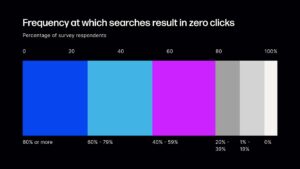
This is what’s known as the zero-click search trend. It’s reshaping user behavior, reducing traffic for content creators, and raising the bar for what content gets seen.
From SEO to GEO: What’s Actually Changing?
Let’s clear something up: SEO isn’t dead. It’s still foundational. But to stay relevant in AI-driven environments, your strategy needs an upgrade. Think of GEO as SEO evolved, less about gaming algorithms and more about creating content that’s too good not to be featured by AI tools.
Instead of just checking boxes like keyword density or page speed, GEO asks:
- Is your content comprehensive?
- Are you answering real user questions in a way AI tools can understand?
- Is your information credible, cited, and current?
Generative engines like ChatGPT rely on large language models (LLMs) trained to prioritize depth, clarity, and context. They prefer content that reads naturally and offers nuanced, trustworthy answers, not keyword-heavy fluff.
What Makes Content GEO Friendly?
If you want your content to be surfaced, cited, or featured in AI answers, it needs to do more than exist. It needs to stand out. Here are a few core principles to focus on:
✅ Natural Language + Real Questions
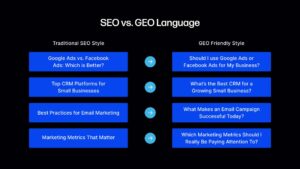
Today’s AI tools operate in conversation mode. That means your content should reflect how people actually speak. Including FAQs, long-tail questions, and a conversational tone increases your chances of being featured.
Example: Instead of titling a blog “Best Dog Foods,” try “What Should I Look for in a Healthy Dog Food?”
✅ Topic Depth and Context
AI values content that goes beyond surface-level information. Instead of writing shallow listicles, aim for comprehensive content that addresses related subtopics, follow-up questions, and real-world examples.
✅ Structured and Skimmable
AI engines scan and summarize. If your content is hard to parse with no headings, hierarchy, or clarity, they’ll likely skip over it. Use clear formatting, strong headings, bullet points, and supporting data.
✅ Credibility and Trust Signals
AI platforms lean on authoritative, factual content. That means citing reliable sources, updating your information frequently, and including expert quotes or original research whenever possible.
✅ Schema Markup and Metadata
Behind the scenes, structured data (like schema markup) helps AI engines understand what your content is about. It doesn’t just help you rank, it helps you get recognized.
Real-World GEO Examples
Let’s say you’re a personal finance brand and want to be featured in ChatGPT’s answer to:
“How can I save money on groceries?” Old-school SEO would tell you to write a 500-word blog post with “save money on groceries” used five times. GEO tells you to:
- Include personal, real-world examples (e.g., meal planning on a budget)
- Offer original insights or curated advice
- Link to studies or consumer behavior data
- Format content into easy-to-scan takeaways
- Include a Q&A section that mirrors how people talk to AI tools
This isn’t just helpful for AI, it’s better for your audience too.
How to Measure GEO Success
If traffic alone isn’t the benchmark anymore, how do you know if GEO is working?
Here’s what to monitor:
- Featured snippets and answer box appearances
- Brand mentions in tools like Perplexity or ChatGPT
- Engagement and time-on-page metrics
- Increases in voice search visibility
- Citations in AI-generated content (using tools like AI Traffic Analytics)
You can also use emerging tools like AI Search Grader and LLM Optimizer to evaluate how well your content aligns with GEO principles.
Common GEO Mistakes to Avoid
Even with good intentions, it’s easy to get GEO wrong. Watch out for:
- Over-optimizing with keywords: If it sounds robotic, it’s not helping.
- Neglecting page updates: AI prioritizes fresh, accurate information.
- Skipping schema: This one small detail can have a big impact on discoverability.
- Using generic content: If your article could’ve been written by anyone, AI might just summarize it without crediting you.
AI Search Isn’t the Future, It’s the Present
We’re entering a new era of search where content quality, depth, and clarity are more important than ever. Generative Engine Optimization isn’t a fad, it’s the next natural evolution in digital strategy. And it doesn’t require a complete overhaul. It’s about refining your content with AI in mind.
At Brandastic, we help brands bridge the gap between what users need and what AI engines are looking for. We create content that connects, whether a human or a machine is reading it.
Want to make sure your content is ready for AI search? Let’s connect.